
A line of jeeps idles at the gate before sunrise. The driver hands you a thermos of tea. Within twenty minutes of entering the park, a leopard is sighted on a rock, and four jeeps converge on the position before you’ve had time to focus your binoculars. He’s magnificent; he’s also visibly used to the audience. You watch for ten minutes, then move on.
The Story
Yala National Park — formally Ruhuna National Park, with Yala its colloquial name — sits on the south-east coast of Sri Lanka, between Tissamaharama and the eastern wilderness. The park covers about 980 square kilometres of dry-zone forest, scrub, lagoons, and coastal beach. It was gazetted in 1900 (under British colonial rule) and is one of the oldest protected wildlife areas in Asia. The park is divided into five blocks; Block 1 is the headline section open to most visitors, with smaller numbers to Blocks 3–5.
Yala is famous for one species above all: the Sri Lankan leopard, Panthera pardus kotiya. Block 1 is widely cited as having the highest leopard density of any leopard habitat in the world — somewhere around one leopard per square kilometre, with the population estimated at 30–40 individuals in this section alone. The combination of high density, the openness of the dry-zone scrub, and the leopards’ relative tolerance of vehicles makes Yala the best leopard-sighting park in Asia. Probabilities for a leopard sighting on a single half-day safari are around 70–80% in the dry season.
The trade-off is the crowd. Yala’s fame draws enormous jeep traffic — particularly to Block 1, where the leopard density is highest. At a sighting of a clearly-visible leopard, you may share the position with 15–25 other jeeps. The Wildlife Department has worked to manage this; convoys are not officially permitted, drivers are supposed to keep moving, and there are limits on jeep numbers per day. In practice, the busy season (December–March) can feel like a queue.
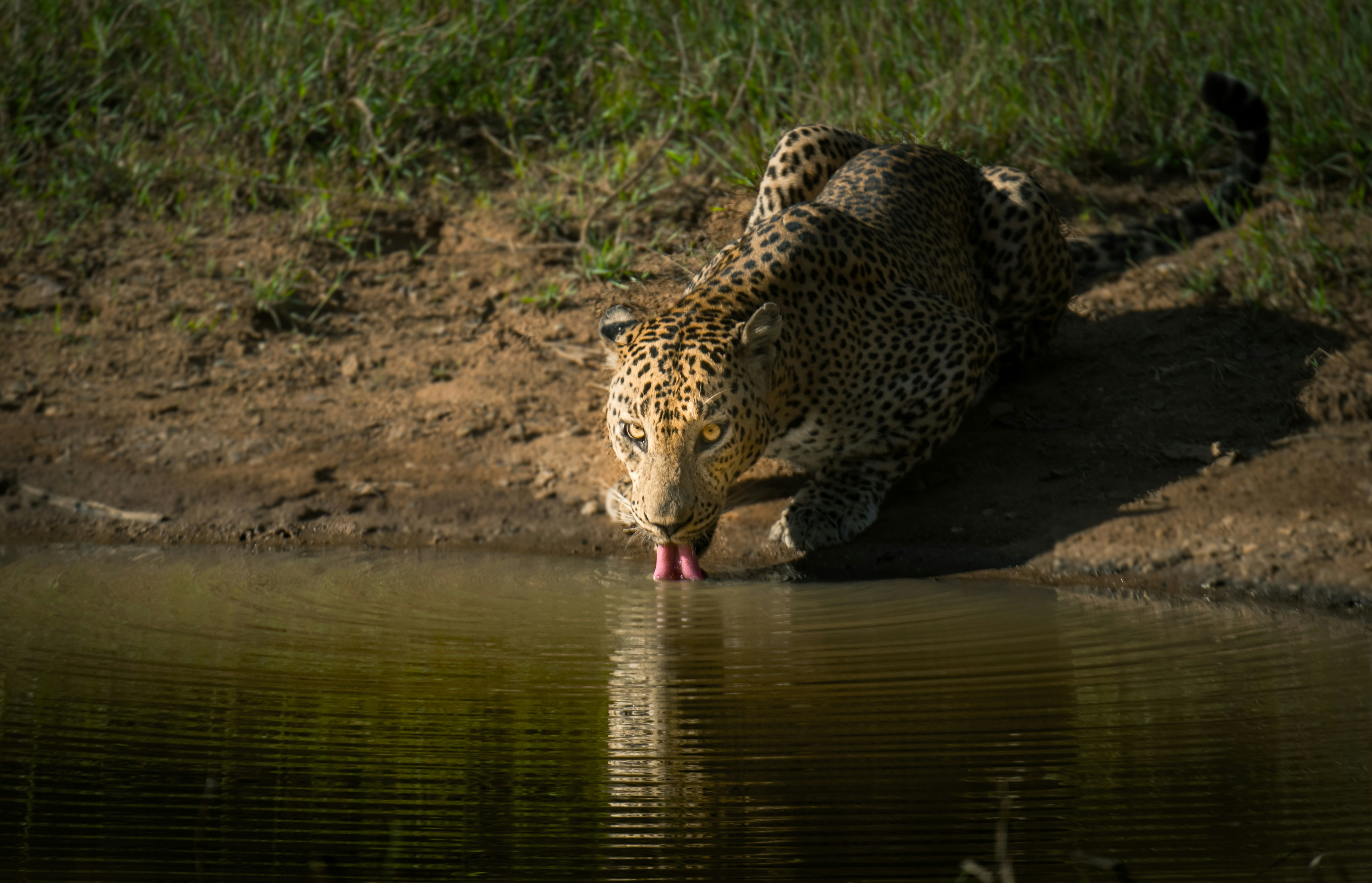
Other species are abundant. Sri Lankan elephants live in the park (lower density than Udawalawe, but visible); sloth bears are present; mugger crocodiles bask on every lagoon edge; spotted deer cross the road in herds; sambar deer prefer the deeper forest; and the bird life is exceptional, with species ranging from sea eagles on the coast to forest birds inland. The image in our caption a leopard at the waterhole — leopard drinking — is a Yala specialty. The image peacocks dance through the bush — a peacock display — captures the supporting cast.
Yala’s coastal section was hit hard by the 2004 tsunami; the wave reached the park boundaries with significant force, killing wildlife and destroying park infrastructure. The current rebuild has been steady, with the park gradually returning to its pre-tsunami visitor scale.
What You'll Experience
Pickup from your Tissamaharama hotel at 5:00am for the dawn safari. The first vehicles through the gate at 6am have the best chance of an undisturbed sighting. The driver is a park-licensed jeep operator; we work with operators we trust who avoid the worst convoy behaviour and who know the leopard territories.
Inside the gate, the road is sandy track through low scrub and open grass. Within an hour, you’ll likely have seen multiple bird species, several spotted deer herds, and the first glimpses of larger wildlife — wild boar, perhaps a sloth bear track, the occasional jackal. The park is busy; jeeps pass in both directions; the sound of distant engines is constant.
The leopard sighting, when it comes, is intense. A leopard appears on a rock, in a tree, or crossing a track. The radio chatter on the jeep’s VHF starts immediately; within ten minutes, four to twenty other jeeps have arrived. The driver positions for the best angle; you have perhaps 5–10 minutes of viewing before the leopard moves on or the jeep convoy disperses. The image a leopard rests in the dry-zone shade lands here. The leopard, in our experience, is usually quite calm about the audience.
Beyond the leopards, the safari rounds out with other wildlife. The image elephants share the same plains refers to herds of 5–15 elephants visible at the lagoon edges. Crocodiles bask on every shore. Peacocks display in the open. By the late morning, the heat is building and you head for the gate. Total time inside the park is typically 4 hours; with the drive in and out, 5–6 hours total.
If you have the choice, opt for the late-afternoon safari (3pm–6pm) instead of the dawn. The afternoon is quieter — many tourist groups do dawn — and the light at sunset on the dry-zone is particularly beautiful. Leopards are also active in the late afternoon, and the cooler hour brings out wildlife at the water sources.
Practical Details
- Location: About 30 km east of Tissamaharama, Southern Province
- Getting There: About 4 hours by car from Colombo via the Southern Expressway, 1.5 hours from Mirissa, 30 minutes from Tissamaharama. Park-licensed jeep required for the safari itself.
- Best Time to Visit: February to June for the dry season, when wildlife concentrates at water sources. September: Block 1 closes for the annual maintenance period — verify dates. Avoid October–January (north-east monsoon).
- Entry: Park fee plus jeep hire — typically around USD 80–120 per person for a shared half-day safari (verify current rates). Block 1 is most expensive; Block 5 is cheaper but less leopard-rich.
- What to Bring: Layers (cool at dawn, hot by mid-morning), sunscreen, hat, dust scarf, binoculars (10×42), zoom lens (300mm+ ideal), water (1.5L+), light snack.
Pair It With
- Tissamaharama Lake — Sunset on the lake bund the evening before — wild elephants without a park ticket.
- Kirinda Beach — A dawn beach walk and temple visit before the morning safari.
- Wilpattu National Park — On a longer Sri Lanka trip — pair both leopard parks for comparison.
Why It Belongs on Your Sri Lanka Journey
Yala is the headline safari of Sri Lanka, and it remains the highest probability leopard-sighting park in Asia. We recommend it for first-time wildlife travellers whose primary goal is leopards, and we typically build a Yala stay into trips with two nights in Tissamaharama, a sunset lake walk, a dawn or afternoon safari, and a slow morning afterwards. For travellers who want a quieter wildlife experience and don’t mind smaller odds, Wilpattu is the better choice; for travellers focused on elephants over leopards, Udawalawe wins. For Belgian and Dutch travellers building a once-in-a-lifetime Sri Lanka trip, Yala on a single afternoon — careful operator, late slot, patient pace — is usually the right call.
Plan your visit to Yala National Park with DBRO
We design slow, considered Sri Lanka itineraries from our base on the island, with a particular ear for travellers from the Netherlands and Belgium. If Yala National Park is on your shortlist, we’ll fit it into a route that lets it breathe.
Useful next reads:


