
A jeep cuts the engine on a sandy track. Up ahead, in the shade of a tamarind tree, a leopard lifts its head — pale gold and rosette, perhaps 30 metres away. There’s no other jeep in sight. You sit silent for ten minutes, watching the slow turn of its head, the flick of its tail. Then it stands and walks unhurried into the bush.
The Story
Wilpattu National Park is the largest national park in Sri Lanka, covering about 1,300 square kilometres of dry-zone forest, scrub, and a series of natural rainwater lakes called villu — from which the park takes its name (villu-pattu, the land of lakes). The park sits in the north-west of the island, north of Anuradhapura and on the road to Mannar; the entrance gate is about 4 hours by car from Colombo or 90 minutes from Anuradhapura.
Wilpattu was Sri Lanka’s premier wildlife destination through the 1960s and 1970s, more famous than Yala. The civil war (1983–2009) closed the park entirely from the late 1980s; the surrounding region was contested territory, and the park infrastructure largely collapsed. Reopening was slow — the gates returned to public access in 2010 — and Wilpattu has only gradually rebuilt its visitor numbers since. The result is the quiet that defines the park today: jeep traffic is roughly a quarter of Yala’s, sightings are less crowded, and the wild character of the place is more intact.
The headline species is the Sri Lankan leopard. Wilpattu has one of the highest leopard densities in Asia, and the park’s relatively open terrain — a mix of scrub and the open villu lake-edges — means leopards are reasonably visible during morning and afternoon safaris. The park is also home to elephants (lower density than Udawalawe, but commonly visible), sloth bears (rare and prized sightings, particularly in the palu fruit season of June–July), spotted and sambar deer, mugger crocodiles, and over 100 bird species. The image in our caption leopard in the dry-zone shade — a resting leopard — captures the kind of moment Wilpattu delivers, often without a queue.
The trade-off is that sightings can take longer. With less jeep traffic, you don’t benefit from the quick radio-grapevine that Yala drivers use to find leopards. You have to be patient, drive slowly, and trust your driver’s knowledge of the territory. The pay-off, when it comes, is usually one or two leopards seen quietly and at length, rather than briefly through a queue of twenty jeeps.
What You'll Experience
Pickup from your Wilpattu base at 5:30am for the dawn safari. The first jeep through the gate has the best chance of an undisturbed sighting; arrive at the entrance around 6am. The driver is a park-licensed jeep operator; we work with a few we trust who have the territory mapped in their head and avoid the busier areas of the park.
Inside the gate, the road is sandy track through low scrub. The first hour is mostly birds and the slow scan: peacocks crossing the road, sambar deer in the shadow of trees, the occasional jackal. Sloth bears are the great prize of June–July when the palu fruit ripens and bears are visible at the trees feeding; outside this window, sloth bear sightings are exceptional.
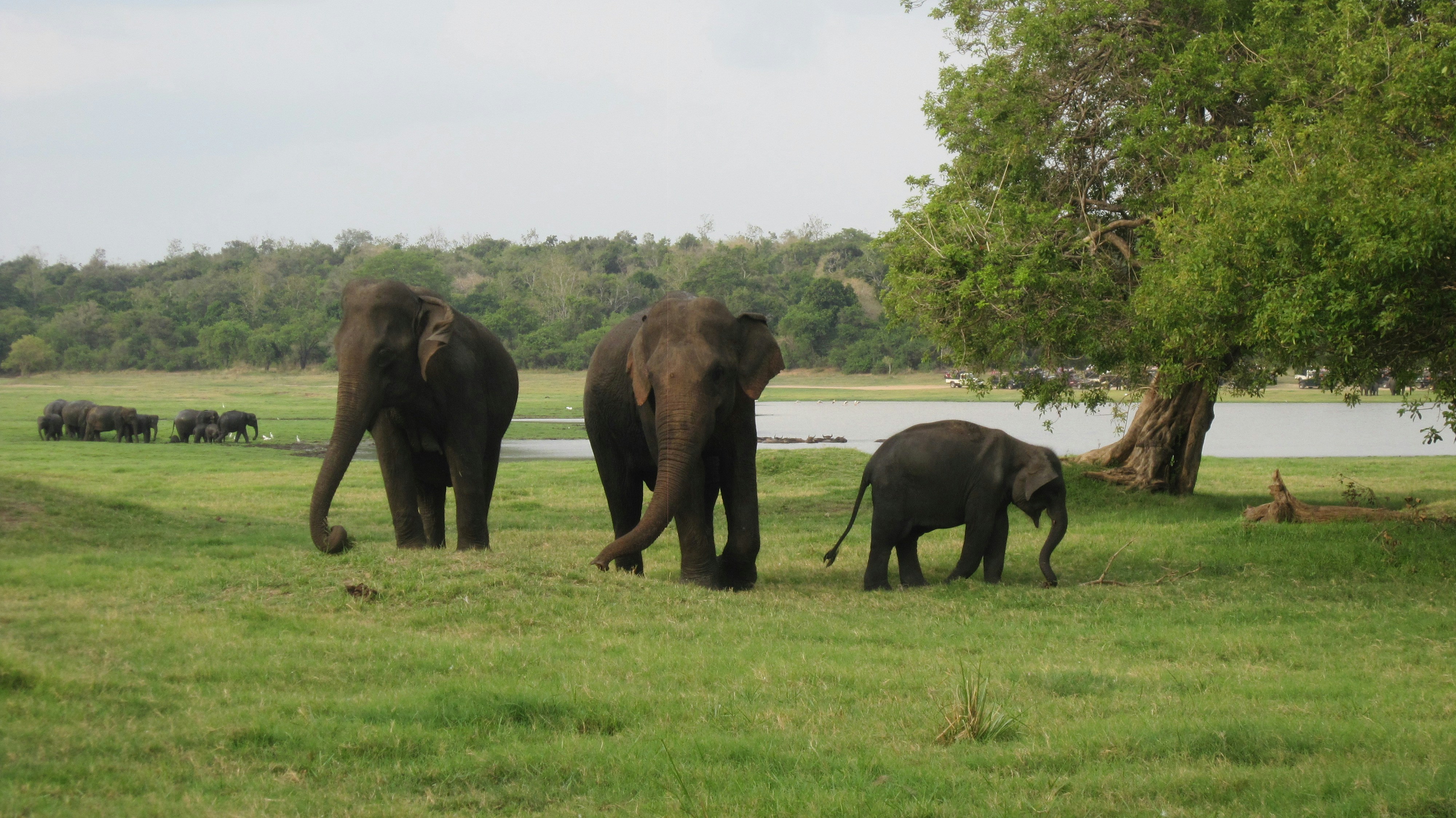
After about 90 minutes you’re typically at one of the villu — the natural rainwater lakes. The image in our caption a herd at the lake’s edge — wild elephants on lake-side grass — captures the geography. Sit at the lake edge for 20 minutes. Crocodiles bask. A water buffalo waddles in for a drink. A herd of 8–10 elephants emerges from the bush opposite.
The leopard sighting, when it comes, is unhurried. The jeep cuts the engine. You may have ten or fifteen minutes of unbroken viewing — far longer than at Yala, and often without another jeep arriving. The image a leopard rests in the dry-zone shade lands here. The leopard is utterly unbothered by you.
Other wildlife rounds out the morning. Spotted deer cross the track. A line of jungle fowl scuttles into the bush. By 10:30am, the heat is building and the wildlife retreats; you head for the gate. The image Wilpattu’s coast hosts gentle wildlife too — sea turtles in the western coastal section — refers to the park’s coastline, accessible if you extend the safari toward Kudiramalai for the afternoon. Total safari time is typically 5 hours including the drive in and out.
Practical Details
- Location: About 30 km west of Anuradhapura, North Western Province
- Getting There: About 4 hours by car from Colombo, 90 minutes from Anuradhapura, 2.5 hours from Sigiriya. A private driver and a park-licensed jeep is the standard setup.
- Best Time to Visit: February to October. June–July is the palu fruit season for sloth bears. Avoid November–January (north-east monsoon — park access is poor).
- Entry: Park fee plus jeep hire — typically around USD 70–110 per person for a shared half-day safari (verify current rates).
- What to Bring: Layers (cool at dawn, hot by 9am), sunscreen, hat, dust scarf, binoculars (10×42), zoom lens, water (1.5L+), light snack.
Pair It With
- Kudiramalai Point — Combine a morning safari with an afternoon at the western headland — a full wild day.
- Anuradhapura — Sri Maha Bodhi — A 90-minute drive east — pair Wilpattu with Cultural Triangle heritage.
- Yala National Park — On a longer Sri Lanka trip, pair both leopard parks across two regions for comparison.
Why It Belongs on Your Sri Lanka Journey
Wilpattu is the safari park for travellers who would rather wait quietly for the leopard than queue with twenty jeeps for a brief sighting. We recommend it specifically over Yala for couples and small groups who value the wildness of the experience over the volume of sightings; for first-time wildlife travellers in a hurry, Yala’s odds are still better. Build Wilpattu into a Cultural Triangle itinerary that includes Anuradhapura and Sigiriya, with two nights at a small Wilpattu lodge between the heritage and the hill country. For Dutch and Belgian travellers thinking carefully about the ethics and quality of safari time, Wilpattu is the kinder answer.
Plan your visit to Wilpattu National Park with DBRO
We design slow, considered Sri Lanka itineraries from our base on the island, with a particular ear for travellers from the Netherlands and Belgium. If Wilpattu National Park is on your shortlist, we’ll fit it into a route that lets it breathe.
Useful next reads:

