
A jeep crests a small rise on the open plain and you see them first as moving grey shapes against tall grass — a herd of about thirty elephants, maybe forty, crossing in a slow line. Calves trot to keep up. The matriarch leads. The light is gold; the cicadas saw away in the heat; and you stay still in the jeep, completely.
The Story
Udawalawe National Park sits in the dry-zone southern lowlands, about 165 kilometres south-east of Colombo, around the Udawalawe Reservoir — a major irrigation tank built in the 1960s. The park was gazetted in 1972 to protect both the reservoir’s catchment and the elephant habitat displaced by its construction. It now covers about 308 square kilometres of mixed grassland, scrub forest, and lake-edge habitat, and supports one of the highest densities of wild Asian elephants in the world.
The park’s unique character is the open plain. Where Yala and Wilpattu are dense scrub-and-forest, Udawalawe is largely open grassland with scattered trees. The visibility is exceptional — you can see across long stretches of plain, with elephants visible at distances of 200–500 metres, and the herd structure (matriarch in front, females, calves, occasional bulls at the edge) clearly readable. For elephant photography and for first-time safari travellers, the openness makes Udawalawe the easier and more reliable park.
Elephant numbers in the park are estimated at around 600–700 individuals, with herds of 30–50 commonly visible from a single safari position. The park is famous for the long-tusked bulls that occasionally appear; tuskers are rare in the Sri Lankan elephant population (less than 7% of males have full tusks, compared to over 60% in mainland Asian populations), so a tusker sighting is a genuine moment.
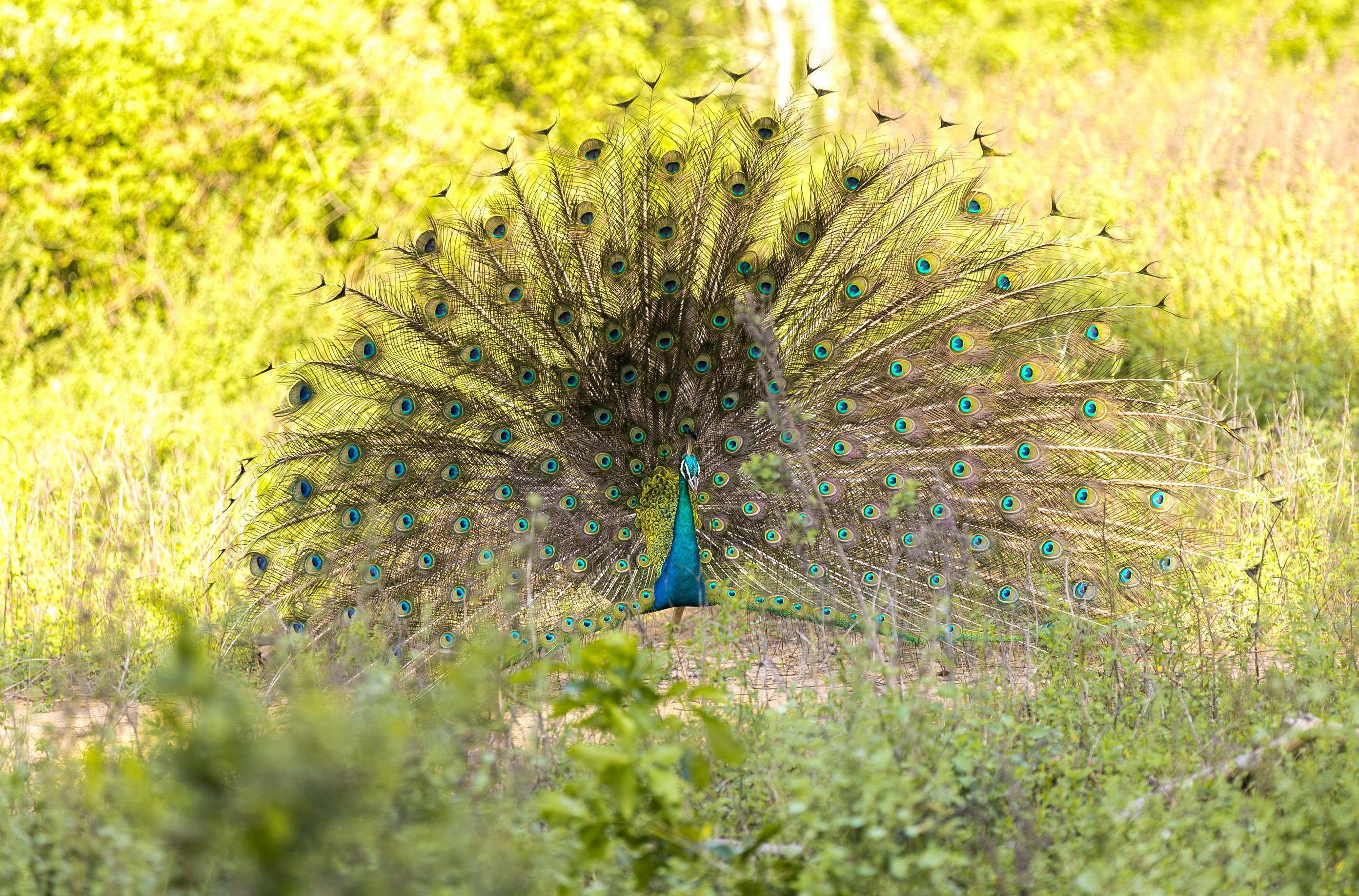
Other species are present. Sri Lankan leopards live in the park but at lower densities than Yala or Wilpattu; sightings are exceptional but possible. Sloth bears, sambar deer, jackals, mugger crocodiles, water buffalo, and a long list of birds — including the spectacular displaying peacocks that pose conveniently on the lower branches in the dry season — fill out the supporting cast. The image in our caption a herd cuts across the open plain is exactly the elephant geography Udawalawe is famous for.
What You'll Experience
Pickup from your Udawalawe area hotel at 5:30am for the dawn safari, or 2:30pm for the dusk safari. Both work. Dawn offers cooler temperatures, more active animals, and better light for the first hour; dusk offers the gold-hour light at the end of the safari and is generally more comfortable for travellers who don’t love a 5am alarm.
The jeep is a Mahindra or Tata 4×4 with raised seats, an open back, and a bench layout that gives everyone a clear view. Park-licensed drivers are required; we work with a few we trust who know the herds and avoid the worst of the jeep convoys at popular sightings. Gate-side queues at peak times can be 20–30 minutes; bring water and patience.
Inside the park, the road threads across open grassland. Elephants appear quickly — sometimes within ten minutes of the gate. The driver positions the jeep at a respectful distance (the wildlife code requires a minimum 30-metre approach for elephants), kills the engine, and you watch. Herds are unhurried. A matriarch pauses to test the wind. Calves pull at grass. A bull stands at the rear, ears wide.
Move along. Within an hour you’ve typically seen multiple herds, perhaps 100 elephants in total. The image in our caption peacock fans against the bushland — a displaying peacock — refers to the way Udawalawe’s open habitat lets you see displays and behaviours that get hidden in denser parks. Water buffalo wade in the reservoir shallows; mugger crocodiles bask on the banks; sambar deer cross the road in small groups.
By the end of the safari, you’ll have learned to read elephant body language a little — ear position, trunk movement, the slow nod of the matriarch — and you’ll have one or two photographs you’ll keep for years. The image elephants at the water’s edge — a herd at the reservoir at dusk — is the kind of shot Udawalawe delivers regularly. Drive back to your hotel for an unhurried dinner with the day still in your eyes.
Practical Details
- Location: About 165 km south-east of Colombo, Uva Province
- Getting There: About 4 hours by car from Colombo, 1.5 hours from Ella, 2.5 hours from Mirissa. A private driver and a separate park-licensed jeep is the standard setup.
- Best Time to Visit: Year-round; the dry season May–September concentrates wildlife at water sources. Dawn (5:30am pickup) and dusk (2:30pm pickup) safaris both work.
- Entry: Park fee plus jeep hire — typically around USD 60–90 per person for a shared safari (verify current rates).
- What to Bring: Layers (cool at dawn, warm by mid-morning), sunscreen, hat, dust scarf or buff, binoculars (10×42), zoom lens if you have one, water (1L+), light snack.
Pair It With
- Elephant Transit Home — Pair the wild herd with the rescued calves — a complete Udawalawe day.
- Yala National Park — On a longer southern itinerary — Udawalawe elephants and Yala leopards in two consecutive mornings.
- Ella Rock — Continue to the hill country — Udawalawe to Ella is a 90-minute scenic drive.
Why It Belongs on Your Sri Lanka Journey
Udawalawe is the most reliable elephant safari in Sri Lanka, and the park we recommend for travellers whose first priority is elephants — the open plain, the visible herds, and the absence of jeep traffic at the better sightings make it the easier park than Yala for first-time wildlife travellers. We typically build it into trips as a one or two-night stop between the south coast and the hill country, with a dawn safari on the first morning, the Transit Home feeding at noon, and an unhurried afternoon before continuing to Ella. For Belgian and Dutch families looking for the genuine wildlife experience without the leopard-traffic of Yala, Udawalawe is the answer.
Plan your visit to Udawalawe National Park with DBRO
We design slow, considered Sri Lanka itineraries from our base on the island, with a particular ear for travellers from the Netherlands and Belgium. If Udawalawe National Park is on your shortlist, we’ll fit it into a route that lets it breathe.
Useful next reads:

