
The drum-line starts somewhere deep in the temple — a slow, escalating beat that pulls you forward through the inner halls. White-clad pilgrims press lotus flowers to their foreheads. A door opens, briefly, onto a small gold-cased shrine, and the line moves you past it before you can quite believe what you’ve seen.
The Story
The Sri Dalada Maligawa — the Temple of the Sacred Tooth Relic — is the most important Buddhist site in Sri Lanka. It houses what tradition holds to be a tooth of the Buddha himself, recovered from his cremation pyre in the fifth century BCE and brought to Sri Lanka in the fourth century CE concealed, the chronicles say, in the hair of an Indian princess. Whoever held the tooth held the kingship of the island; the relic was therefore moved with each successive capital — Anuradhapura, Polonnaruwa, Yapahuwa, Kurunegala — until it came to rest in Kandy in the 16th century with the rise of the Kandyan kingdom.
The temple itself sits at the foot of the wooded hill that holds the old Royal Palace, on the northern shore of Kandy Lake. The current structure dates mostly from the 17th and 18th centuries: a series of low pavilions in white plaster and dark wood, gilded roof finials, a moat, an elaborate octagonal pavilion (the Pattirippuwa) added in the 1790s. The complex was bombed in 1998 by separatist insurgents during the civil war; the damage was repaired, the relic was unharmed, and the site became, if anything, a more potent symbol of Sinhalese Buddhist resilience after the war.
Three times a day — 5:30am, 9:30am, and 6:30pm — the inner shrine room opens for puja, the ritual offering. The drumming starts on the lower level and rises through the temple. The faithful press in to glimpse the gold casket of the relic; the line is slow but well-managed; nobody is rushed. The relic itself is never displayed — it sits inside a series of nested gold reliquaries, each one revealed only on the rarest of occasions. What you see is the outermost casket, and the moment of seeing it is, for many Sri Lankans, the spiritual centre of their lives.
What You'll Experience
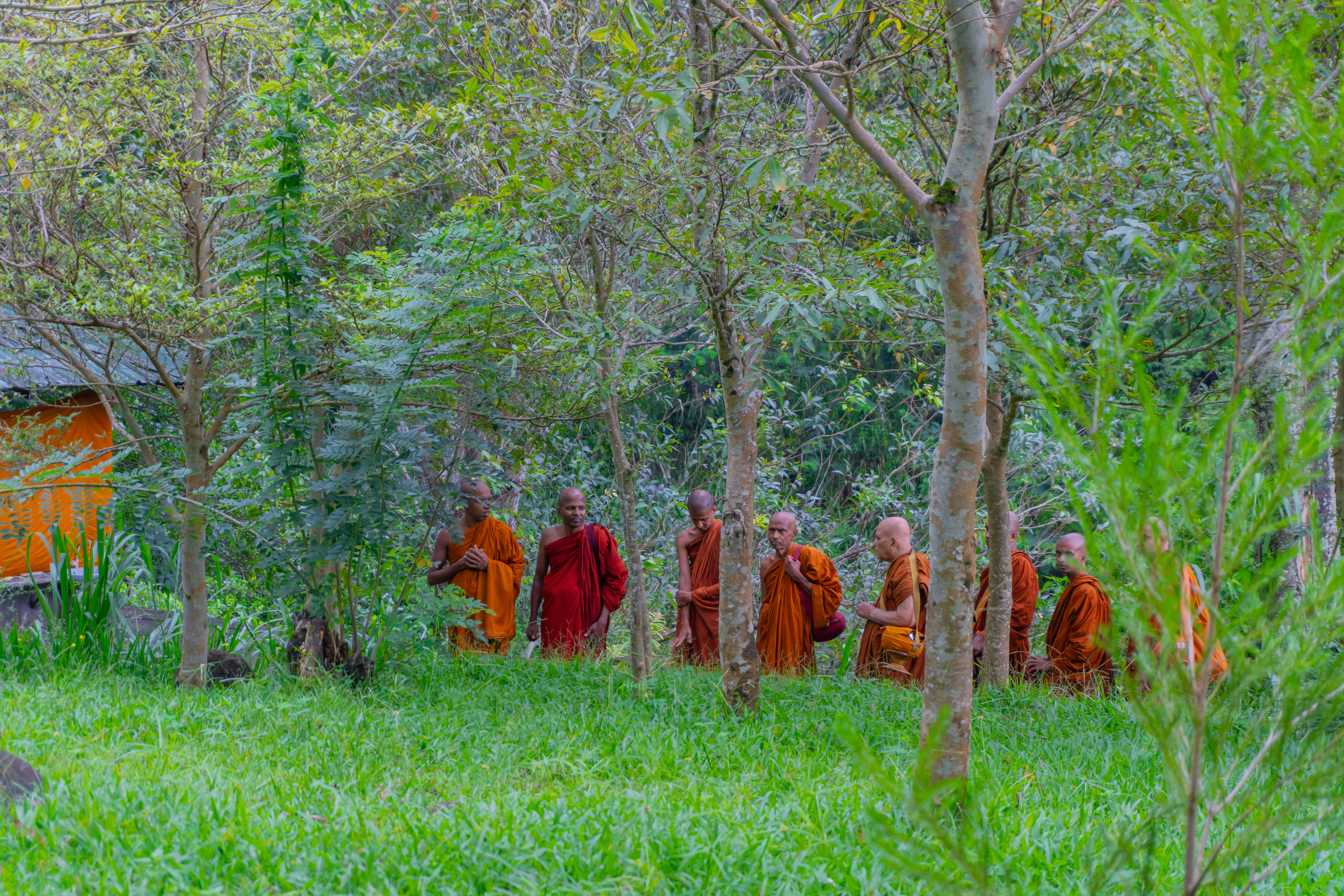
Go at the morning puja, around nine, or the evening one at half past six. Avoid the middle of the day when the temple is closed to visitors. Arrive twenty minutes early; security is real but courteous, and you’ll need to clear bag check, leave shoes at the gate, and pay the foreign visitor fee. Dress is conservative — shoulders and knees covered, no sleeveless tops, no shorts. Many of our travellers wear a long cotton shirt over what they have on; a sarong works for both men and women.
You enter through the moat gate and across the inner courtyard, white pilgrims streaming alongside you. The drumming begins above; you climb the broad teak staircase to the upper level. The inner shrine room is small. The line moves slowly past a wooden lattice through which you glimpse, for a few seconds, the gold casket on its raised dais, oil lamps burning in front of it, monks in saffron in the half-dark behind. People press flowers, hold them briefly, leave them on a low platform. The line carries you on.
Don’t leave straight away. Walk the upper galleries, where painted murals tell the story of how the relic came to Sri Lanka. Sit in the smaller meditation hall behind the main shrine for ten minutes and listen to the chant. The sound of the temple at the lake’s northern shore, in our photo caption, is the sound of this drum. By the time you walk out into the courtyard the light will have changed; the lake will be silvered for the evening, and the day will feel a little different than it did when you came in.
Practical Details
- Location: Northern shore of Kandy Lake, central Kandy, Central Province
- Getting There: A 5-minute walk from any central Kandy hotel. About 3 hours by car from Colombo on the new expressway.
- Best Time to Visit: Year-round. Visit during a puja (5:30am, 9:30am, or 6:30pm). Avoid the lunchtime closure (typically 11:30am–1:30pm).
- Entry: Around USD 10–15 for foreign visitors (verify current rates). Cameras allowed but no flash inside the inner shrine.
- What to Bring: Modest clothing covering shoulders and knees, a sarong as backup, socks if you’re sensitive to warm stone, water for after the visit.
Pair It With
- Kandy Lake — Walk the lake circuit before the morning puja or after the evening one.
- Royal Botanical Gardens — Combine with a morning in Peradeniya for a full Kandy day.
- Ambuluwawa Tower — A half-day trip out to the spiral tower at Gampola — a fine contrast to the temple’s quiet.
Why It Belongs on Your Sri Lanka Journey
Of all the religious sites in Sri Lanka, the Temple of the Tooth is the one travellers most often tell us they returned to a second time. It rewards a slow visit. Don’t schedule it as a 30-minute box-tick on a Cultural Triangle day; build a Kandy stay of two nights and visit at least one full puja. Pair it with a walk around Kandy Lake at first light and a morning in the Royal Botanical Gardens, and you’ll begin to understand why the city is the spiritual centre of the island and not just the most photogenic of its hill towns.
Plan your visit to Temple of the Tooth with DBRO
We design slow, considered Sri Lanka itineraries from our base on the island, with a particular ear for travellers from the Netherlands and Belgium. If Temple of the Tooth is on your shortlist, we’ll fit it into a route that lets it breathe.
Useful next reads:

