
A small wind moves through the heart-shaped leaves and the entire courtyard seems to breathe. White-clad pilgrims sit on the warm stone with their eyes half-closed, listening to a tree planted before any cathedral in Europe was even imagined.
The Story
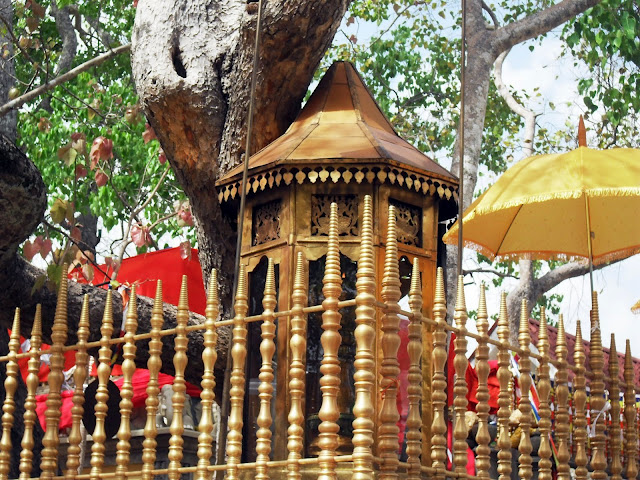
In 288 BCE, the nun Sanghamitta — daughter of the Indian emperor Ashoka — sailed from Bodh Gaya to Anuradhapura carrying a single sapling: a cutting from the Bodhi tree under which the Buddha is said to have attained enlightenment. The sapling was planted in the centre of the new royal capital, and tended by an unbroken line of guardians ever since. The tree growing in the courtyard today, propped now on golden supports, is that same tree. By documented history it is the oldest planted tree on earth.
The original parent tree at Bodh Gaya in India did not survive — it was cut down, burned, replanted, and ultimately lost. The Sri Lankan offspring outlived its parent. Over the centuries cuttings from this tree have been carried around the Buddhist world, including back to Bodh Gaya, where the current tree there is technically a granddaughter of the one in Anuradhapura.
The precinct around the tree is a working temple. There are smaller bodhi saplings — the children and grandchildren of the parent — clustered around it in the courtyard, each protected by a stone wall and a layer of devotional flags. Monks and laypeople come daily to chant; on full-moon days the precinct fills with thousands of devotees in white. Standing in the shade of the tree you’re close to the doctrinal heart of Theravada Buddhism, and to a single living organism that has watched twenty-three centuries of empire, war, drought, and rain pass beneath its leaves.
What You'll Experience
You enter through a long covered walkway, leaving shoes at the gate. The path is paved in cool grey stone — kind to bare feet — and lined with offering stalls selling lotus blooms, frangipani garlands and oil lamps. A small donation buys a cluster of flowers; you carry them in front of you like everyone else does.
The courtyard itself is a tiered platform of white walls, and in the centre, on a raised altar, the tree spreads its branches — gnarled, gold-supported in places, the leaves a clear pale green. You leave your flowers on the altar with the others; you fold your hands in the way the people around you fold theirs.
There is no rush. You sit on the warm stone among devotees, monks in saffron, families with small children. A flag flutters somewhere overhead. A monk in a corner is leading a low, melodic chant — the Tisarana, the going for refuge. A leaf lets go and drifts down. Travellers from Europe sometimes describe this place as quieter than they expected and more profound; even visitors with no Buddhist background find the long, layered devotion of the place lands with them. You stay longer than you meant to. You leave gently.
Practical Details
- Location: Sacred city precinct, Anuradhapura, North Central Province
- Getting There: Within walking distance of Ruwanwelisaya. Most travellers visit both the same morning. About 4 hours by car from Colombo.
- Best Time to Visit: Sunrise is ideal — cool, soft light, and few crowds. Full-moon poya days are crowded and very atmospheric if you don’t mind the crowd.
- Entry: Covered by the Sacred City combined ticket (around USD 25 — verify current rates). A small additional donation is customary.
- What to Bring: White or modest light-coloured clothing, shoulders and knees covered. Bring socks for the heat of midday paving. No camera flash inside the inner precinct; photography of the tree itself is generally fine.
Pair It With
- Ruwanwelisaya — Five minutes’ walk away across the sacred precinct.
- Mihintale — A short drive east — climb at first light, then return for the tree in the afternoon.
- Isurumuniya — A small rock temple a short tuk-tuk away, famous for its 6th-century rock carvings.
Why It Belongs on Your Sri Lanka Journey
Sri Maha Bodhi is the kind of place that recalibrates your sense of time. For a Dutch or Belgian traveller used to medieval cathedrals — three or four centuries old at most — there is something quietly humbling about sitting under a tree that was already old when those cathedrals were planned. Don’t schedule it. Just leave a morning open in your Anuradhapura day for the tree, and let the morning arrange itself.
Plan your visit to Sri Maha Bodhi with DBRO
We design slow, considered Sri Lanka itineraries from our base on the island, with a particular ear for travellers from the Netherlands and Belgium. If Sri Maha Bodhi is on your shortlist, we’ll fit it into a route that lets it breathe.
Useful next reads:

