
You walk through the water gardens at first light, the moats still in shadow, and round a corner to see the rock — a single vertical block of granite 200 metres high, the morning light just beginning to find its eastern face. By the time you’ve climbed the first staircase, the cicadas have started, and you understand, suddenly, why a king once built his palace in the sky.
The Story
Sigiriya — the Lion Rock — is one of the most extraordinary archaeological sites in Asia. The story begins in the late 5th century CE, when Prince Kasyapa overthrew his father, King Dhatusena of Anuradhapura, by walling him up alive. Anticipating the revenge of his half-brother Mogallana, who had fled to India, Kasyapa moved the capital from Anuradhapura to Sigiriya and built — over the course of just seven years — a fortress-palace on top of a 200-metre granite rock that rose vertically out of the surrounding jungle.
The result was a complex of a kind that hadn’t been built before in the region and wasn’t repeated after: vast water gardens at the foot of the rock, a wide moat, terraced approach paths, a covered Mirror Wall polished to a high sheen along the rock face, a series of frescoes painted on a sheltered overhang halfway up, a colossal carved lion gateway at the rock’s shoulder (only the giant paws survive), and finally, on the flat summit, the royal palace itself — pools, throne rooms, audience halls, all carved from the bedrock.
Kasyapa ruled from Sigiriya for eighteen years before Mogallana returned with an army. The two brothers met in battle on the plain below; Kasyapa was defeated and took his own life. Mogallana moved the capital back to Anuradhapura, gave Sigiriya to the Buddhist sangha, and the rock became, for a thousand years afterwards, a working monastery rather than a palace. The frescoes, the gardens, and most of the architectural shell survive today, layered over by Buddhist devotional use.
UNESCO inscribed Sigiriya as a World Heritage Site in 1982. The climb today is up a series of restored staircases — about 1,200 steps in total — through the water gardens, past the frescoes, along the Mirror Wall, between the great lion paws, and onto the summit. The image of Sigiriya Rock from the air in our caption captures the strange isolation of the rock from above; the fortress seen from the gardens is exactly the moment of arrival.
What You'll Experience
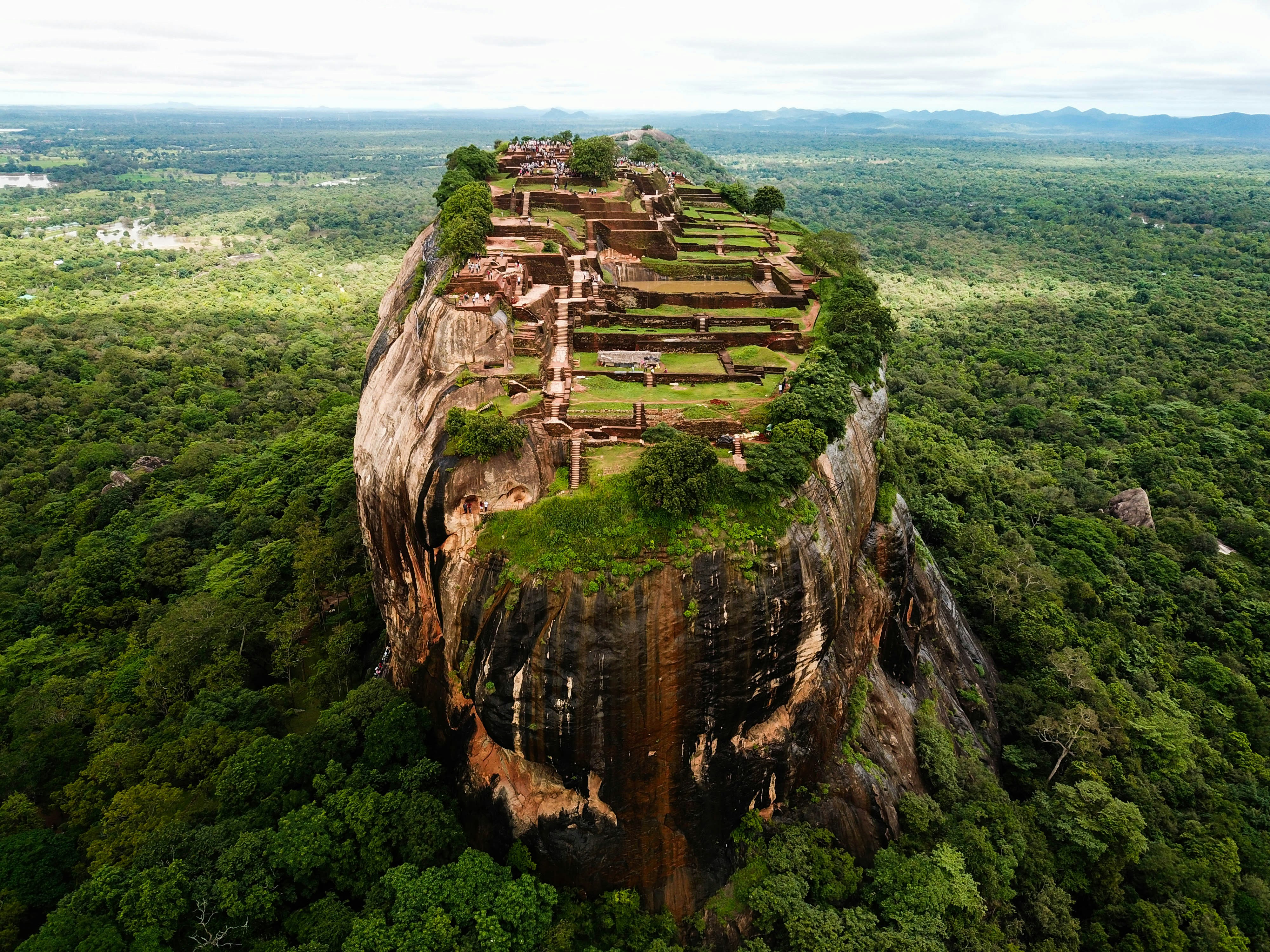
Arrive at the gate at 6:30am, when it opens. The early start matters: by 9am the heat is real, the queue is long, and the view from the top is hazy. The first 20 minutes is a flat walk through the water gardens — a series of symmetrical pools and channels still functioning as they did 1,500 years ago. Look back; the whole layout is best understood from this angle.
The rock itself begins with a stone stair through a chaotic boulder field — the so-called Boulder Garden. The stones here have been displaced by earthquakes, but the original carved features are still visible: meditation platforms, niches for statues, drip-line carvings to keep rain out of caves. Above, the staircase steepens, switchbacking up the rock’s western face.
Halfway up, a small spiral metal staircase climbs to the fresco gallery — a sheltered overhang where 21 painted female figures (out of an original 500, the chronicles claim) survive in vivid colour. The figures are 1,500 years old, painted on plaster that has held its pigment in a way that almost no other South Asian art of the period has. Photography is prohibited in the gallery; spend ten minutes looking instead.
Continue up. The Mirror Wall — a long polished surface along the rock face below the frescoes — is where 6th–14th century visitors scratched poems and graffiti. Then the climb proper begins: a long iron staircase up the rock’s western face, exposed and dramatic. At the lion’s plateau, two enormous stone paws frame the final stair — the head of the lion is gone, but the paws give a sense of the original gateway’s scale.
The final 200 steps are the hardest. The summit opens out — about 1.6 hectares of palace ruins, a reservoir, the rock-cut throne, and a 360-degree view across the Cultural Triangle. The image wild elephants in the surrounding plains in our caption refers to the dry-zone scrub you see from the top — a reminder that the jungle still presses against the rock as it did in Kasyapa’s time. Sit on the warm stone for half an hour. Descend slowly; the descent is harder on the knees than the ascent.
Practical Details
- Location: Sigiriya village, North Central Province
- Getting There: About 4 hours by car from Colombo, 30 minutes from Dambulla. Closest airport for domestic transfers is Sigiriya airfield.
- Best Time to Visit: Dry season May to September. Arrive at gate opening (6:30am) to climb in cool air. Avoid the lunchtime heat.
- Entry: Around USD 35 for foreign visitors (verify current rates). Children pay reduced fees. Cameras allowed except in the fresco gallery.
- What to Bring: Sturdy shoes with grip, water (1.5L minimum), hat, sunscreen, light layer for early morning, modest clothing for the fresco section. Vertigo sufferers should know the staircase has long exposed sections.
Pair It With
- Pidurangala Rock — The shorter alternative climb opposite — visit Pidurangala the day before for the postcard view of Sigiriya.
- Dambulla Cave Temple — A 25-minute drive south — combine with Sigiriya for a full Cultural Triangle day.
- Minneriya National Park — Climb at dawn, rest through midday, safari at 3pm for the elephant Gathering.
Why It Belongs on Your Sri Lanka Journey
Sigiriya is the headline of the Cultural Triangle, and it deserves the early start, the careful climb, and the slow descent. We typically build a three-night Sigiriya stay around it, with Pidurangala as the gentle counterpart, Dambulla for the painted ceilings, and Minneriya for the wild elephants. Travellers from Amsterdam and Brussels often tell us Sigiriya was the moment the trip became real — the climb is unfaked, the view is genuine, and the sense of standing on a 1,500-year-old palace floor is the kind of experience European medieval architecture rarely matches. Take it slowly. Take it early.
Plan your visit to Sigiriya Rock Fortress with DBRO
We design slow, considered Sri Lanka itineraries from our base on the island, with a particular ear for travellers from the Netherlands and Belgium. If Sigiriya Rock Fortress is on your shortlist, we’ll fit it into a route that lets it breathe.
Useful next reads:

