
Round a corner in the sacred city and the Great Stupa rises in front of you like a single perfect cloud, white-on-blue, surprisingly soft against the hard light of the dry zone. Pilgrims walk slow circles around its base, white sashes against white walls, and a small girl runs ahead with a lotus flower the size of her face.
The Story
Ruwanwelisaya — also called the Mahathupa, the Great Stupa — was built by King Dutugemunu in the second century BCE to enshrine relics of the Buddha. The chronicles describe its construction in lyrical detail: the stupa was raised over a relic chamber laid out as a miniature universe, with golden bodhi trees, a golden Buddha image, and pools that supposedly poured perfume rather than water. Whether or not all of that survives below the dome, the architectural fact is that for nearly twenty-two centuries this stupa has been one of the most sacred places in the Theravada Buddhist world.
The dome stands roughly 92 metres high after restoration, on a square platform guarded by a stone wall studded with 344 sculpted elephants. The elephants — the wall’s name in Sinhala is the “elephant wall” — appear to be holding the stupa up on their backs. Tradition has it that the king who commissioned the stupa lay dying before it was finished; his brother stretched a great white cloth over the bamboo scaffolding so that the king could die believing he had seen it complete. The bamboo and the cloth are gone; the white finish is real now, and the elephants are still doing their work.
Around the stupa stretches the rest of the sacred precinct: a flat-topped stone platform, smaller satellite dagobas, and stone railings carved with lotus medallions. Across the precinct, the Sri Maha Bodhi precinct begins; in the other direction, the great brick mass of Jethawanaramaya. You are standing in one of the most concentrated landscapes of religious architecture in the world.
What You'll Experience
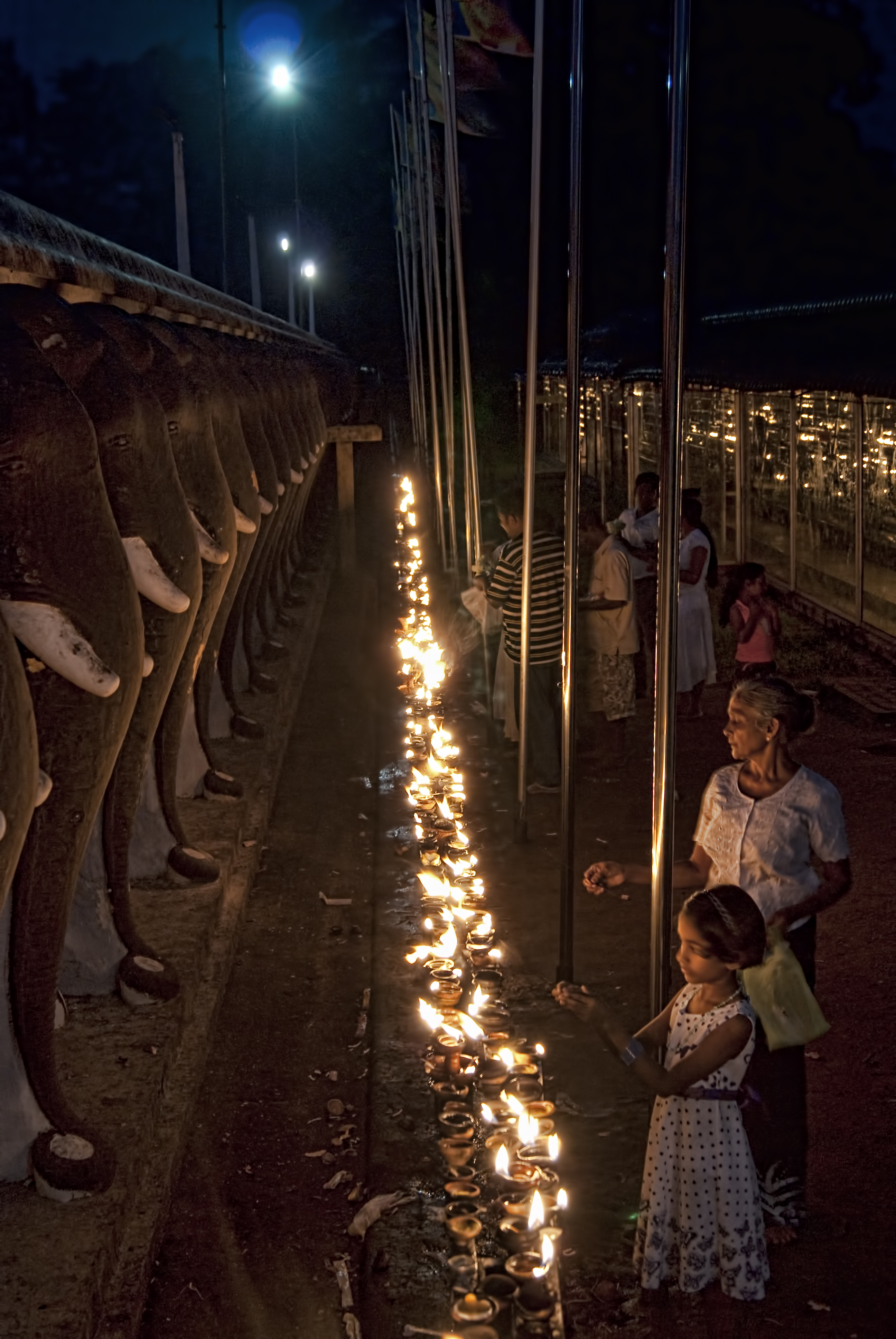
Walk in barefoot. The platform is heat-bright in the afternoon and cool as marble at first light. White-clad devotees move clockwise — pradakshina — and you fall in with them automatically. There’s a softness to the walking pace here you won’t find at any European cathedral.
Stop at the elephant wall and look up close. Each elephant is slightly different: one with a baby calf at its side, one with its trunk raised, one weather-worn into something abstract. The newer elephants from the restoration are easy to spot — sharper edges, brighter stone — and the older ones look almost shy.
Find the four small temples set into the cardinal directions of the dome. Each holds a Buddha image and a small offering area where pilgrims press flowers and pour oil into clay lamps. The smell is ghee, frangipani and warm stone. Sit on the edge of the platform for a while. The dome above you is so smooth and so vast it goes from looking solid to looking weightless and back again, like a held breath. By the time you leave, you’ve circled it three or four times without quite meaning to.
Practical Details
- Location: Anuradhapura sacred city, North Central Province
- Getting There: Inside the sacred city precinct. From most Anuradhapura hotels: 10–15 minutes by tuk-tuk. From Sigiriya: about 3 hours by car.
- Best Time to Visit: Dawn and the hour before sunset are golden — literally — and gentlest on bare feet. Full-moon poya days bring large crowds in white.
- Entry: Covered by the Sacred City combined ticket (around USD 25 for foreign visitors at time of writing — verify current rates).
- What to Bring: Modest clothing (shoulders and knees covered), a sarong, water, hat, and socks if you are sensitive to hot stone.
Pair It With
- Sri Maha Bodhi — A 10-minute walk away — the sacred tree precinct, perfect to combine in a single morning.
- Jethawanaramaya — The raw brick counterpoint to Ruwanwelisaya’s polished white finish.
- Mihintale — The sacred mountain a short drive east. Climb at sunrise, return for Ruwanwelisaya in the late afternoon.
Why It Belongs on Your Sri Lanka Journey
If you only have one image of Anuradhapura to take home, let it be Ruwanwelisaya at sunset — the white dome turning pink against a darkening sky, the slow circle of pilgrims moving with the same patience as the stars overhead. Pair it with a slow morning at Sigiriya, an unhurried evening at Mihintale, and the Cultural Triangle stops being a checklist and starts being something you carry with you.
Plan your visit to Ruwanwelisaya with DBRO
We design slow, considered Sri Lanka itineraries from our base on the island, with a particular ear for travellers from the Netherlands and Belgium. If Ruwanwelisaya is on your shortlist, we’ll fit it into a route that lets it breathe.
Useful next reads:

