
You climb a long staircase through warm forest, past five terraces of small white shrines cut into the rock face, and at the top you stand on a stone platform that opens onto an unbroken view of paddy fields and palm groves stretching inland to the southern hills. The cicadas saw away in the heat; a single monk passes you on the stair with a small smile.
The Story
Mulkirigala Rock Temple — sometimes called Little Sigiriya for its rock-and-monastery similarities to the more famous Cultural Triangle site — is a cave-temple complex carved into a 200-metre granite outcrop about 16 kilometres inland from Tangalle. The earliest caves date to around the 2nd century BCE; the site has been continuously occupied as a Buddhist monastery for over 2,000 years. Successive periods added sculpture and painting: the Anuradhapura kings of the early period, the Kandyan kings of the 17th and 18th centuries, and steady local devotional commissions through to the present day.
The site is laid out across five terraces, climbing up the south face of the rock. Each terrace holds a small white shrine building, with cave temples carved into the rock behind them. The lowest terrace is at ground level; the highest is just below the summit. The total climb is about 533 stone steps; the difficulty is moderate, similar to a flight of stairs to a fifth-floor apartment, but spread out and broken up by the terraces. There is no scrambling, no ladders, no exposure.
The temple is famous in Sri Lankan history for one specific reason: in the 19th century, the British scholar George Turnour found a complete copy of the Mahavamsa — the great chronicle of Sinhalese history — at Mulkirigala. The Mahavamsa is the document that makes most of what we know about Sri Lanka’s pre-modern history possible; without the Mulkirigala manuscript, much of the Anuradhapura and Polonnaruwa story would be lost. The temple has been a place of textual preservation as much as religious devotion.
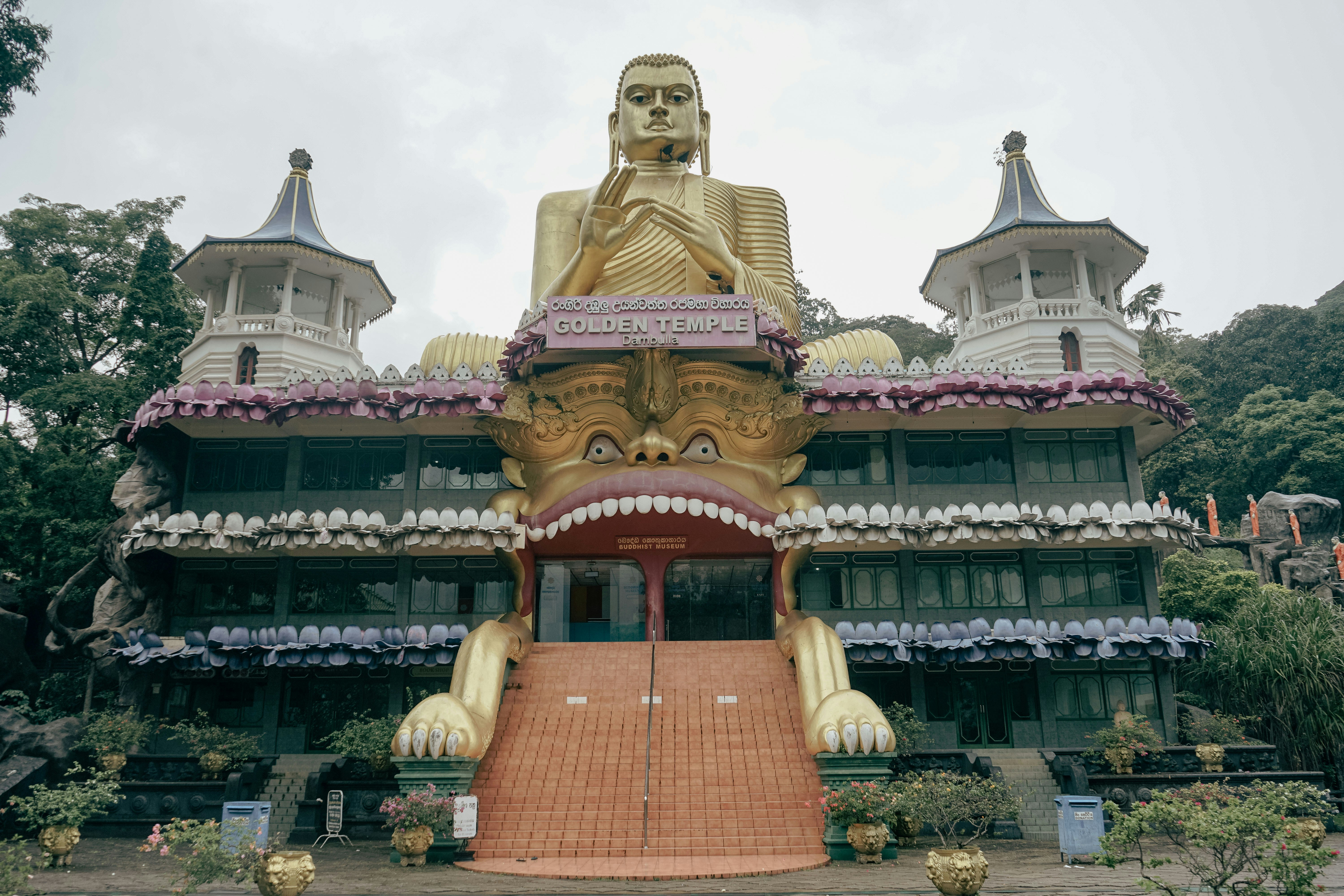
Compared to Dambulla, Mulkirigala is much quieter. Most days you’ll have stretches of the temple to yourself. The sculpture is less ornate than Dambulla’s, but the position — high above the inland plain, with the south coast visible from the upper terraces on a clear day — is unmatched in the southern province.
What You'll Experience
Drive inland from Tangalle in the morning, before the heat builds. The road is small and rural — paddy fields, palm groves, the occasional small village. You arrive at the base of the rock and pay the entrance fee at a small ticket office. Leave shoes at the gate; bring socks if you’re sensitive to warm stone.
The first terrace is at ground level — a small white shrine building with a reclining Buddha cave behind it. The figure is about 15 metres long, painted in the Kandyan style with a clear, slightly angular face. Walk through; light a small oil lamp if you wish.
Climb the staircase to the second terrace. The path is broad, shaded by frangipani in places, and broken up by the terraces themselves. At each terrace, a separate small shrine and cave; the painting style varies, the Buddhas vary, the small bell-towers and stupas vary. The image in our caption rock-cave murals share Mulkirigala’s story lands here — the murals are the temple’s great artistic feature.
The fourth terrace holds the largest of the cave temples — the Mahaviharaya — with a long reclining Buddha (about 12 metres) and a row of standing Buddhas on either side. The painted ceiling above the reclining Buddha is one of the finest 18th-century mural surfaces in the southern province. Spend time here; the cave smells of sandalwood and old plaster.
The summit is reached via the fifth terrace, with a small dagoba and a 360-degree view. From the top, on a clear morning, you can see the southern coastal plain, the palm groves around Tangalle, and on the horizon, the grey haze of the southern sea. Walk back down slowly. The whole visit takes 90 minutes to two hours.
Practical Details
- Location: About 16 km inland from Tangalle, Southern Province
- Getting There: A 30-minute drive inland from Tangalle on a small rural road. Easiest with a private driver; tuk-tuks from Tangalle work but the road is steep at the end.
- Best Time to Visit: November to April. Mornings (before 10am) are coolest. Avoid the midday heat — the rock is exposed and the climb is harder than it looks.
- Entry: Around USD 5–8 per person at the temple gate (verify current rates). Photography permitted, no flash inside.
- What to Bring: Modest clothing covering shoulders and knees, a sarong as backup, socks for hot stone, water (1L minimum), hat, sunscreen, comfortable shoes for the climb.
Pair It With
- Tangalle Beach — Return to the coast for an unhurried afternoon — combine inland temple with beach swim.
- Hiriketiya Beach — A 30-minute drive — pair the temple morning with afternoon yoga at Hiri.
- Dambulla Cave Temple — A different cave temple in the Cultural Triangle — combine on a longer Sri Lanka loop.
Why It Belongs on Your Sri Lanka Journey
Mulkirigala is the south coast’s gentle, undertouristed counterpart to Dambulla — older, smaller, less polished, and almost always quieter. We build it into Tangalle stays as the inland half-day on a slow week of beach days. For Dutch and Belgian travellers used to the layered architecture of European cathedrals, the climb up through five terraces of cave temples reads as a kind of vertical meditation — and the view from the top, over the southern paddy fields, is the kind of moment that lands quietly and lasts.
Plan your visit to Mulkirigala Rock Temple with DBRO
We design slow, considered Sri Lanka itineraries from our base on the island, with a particular ear for travellers from the Netherlands and Belgium. If Mulkirigala Rock Temple is on your shortlist, we’ll fit it into a route that lets it breathe.
Useful next reads:

