
A jeep idles at the gate before sunrise, the headlights picking out the eyes of a deer at the edge of the road. You have a thermos of tea between your knees. By the time the dawn breaks properly, you are deep in a park most travellers have never heard of.
The Story
Kumana — once known as Yala East — sits on the eastern edge of Sri Lanka’s southern wildlife corridor, separated from Yala proper by a long stretch of impassable bush and lagoon. Officially gazetted as a national park in 2006, the area has been a wildlife reserve for far longer; it’s on the migration route for hundreds of bird species, and the lagoons of the Kumana Bird Reserve have been a Ramsar wetland for decades.
The park is best known for its birds — pelicans, egrets, painted storks, ibises, the spectacular Asian openbill. From May to August the bird sanctuary becomes a nesting site of international importance, with thousands of pairs raising chicks in the mangroves. Between the birds you’ll find elephants, sambar deer, wild boar, and — for the patient — leopards. Kumana’s leopard density is lower than Yala’s, but the trade-off is that you may have a sighting almost entirely to yourself, with one or two jeeps rather than twenty.
The east-coast climate runs counter to the south-west. Where Yala is best from January to April, Kumana is at its driest and most generous from May through September — exactly the months Yala’s southern blocks close for the monsoon. For travellers planning a Sri Lanka trip in the European summer, Kumana is the safari park that actually cooperates with your calendar.
What You'll Experience
You leave Arugam Bay before five. The first hour is cool — almost cold — and the road threads through rice fields and small villages where the temple dawn drums are just beginning. By the time you reach the gate the light is rose-pink on the lagoon water.
The first hour inside the park is mostly birds. Painted storks stand in the shallows like still-life paintings; a serpent eagle launches off a dead branch and circles. Your driver kills the engine often. He listens for alarm calls — the warning bark of a sambar, the chip of a peacock — and that’s how you find the predators.
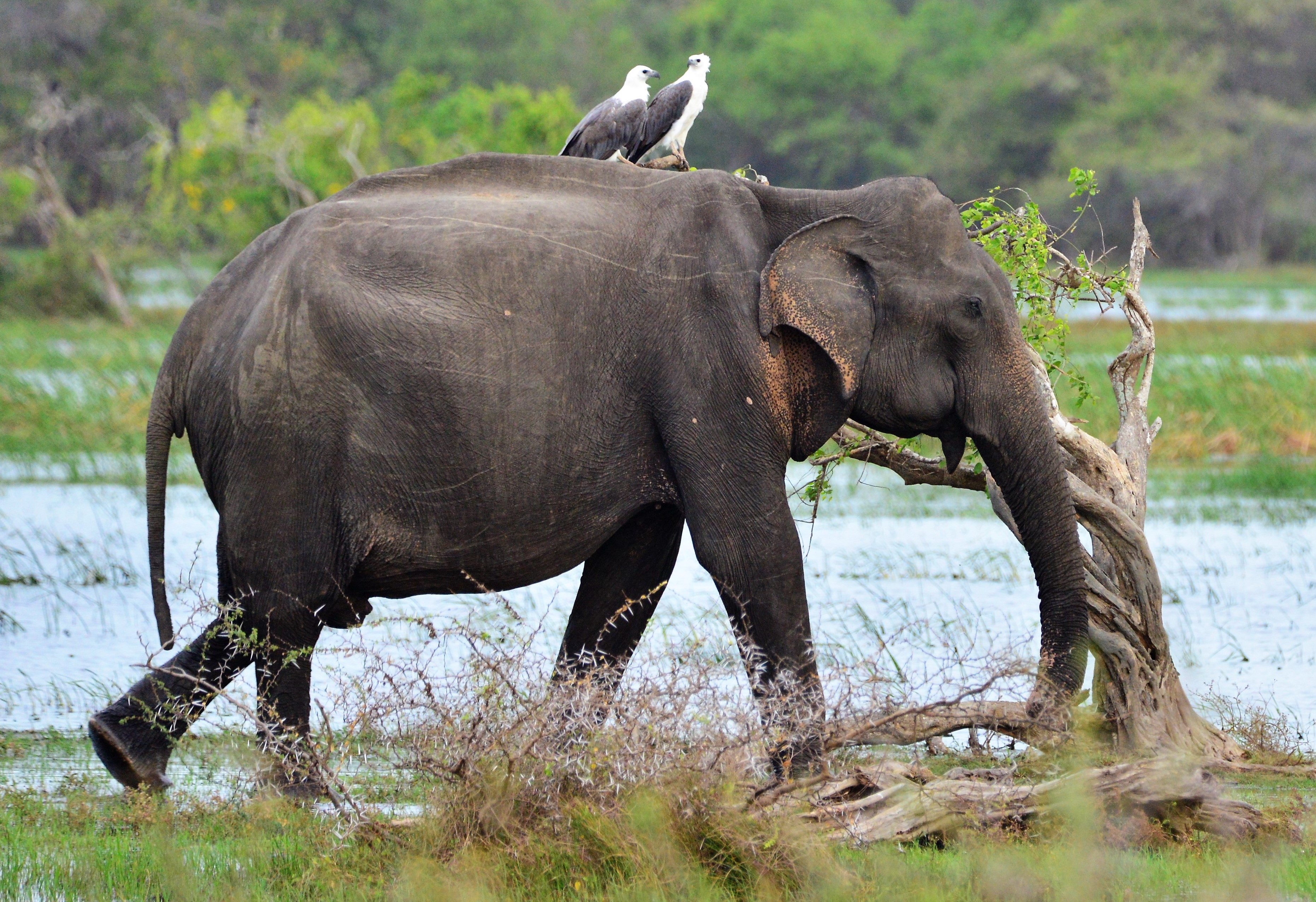
A jackal trots across the track. Wild boar with striped piglets crash through the underbrush. You round a bend and suddenly there is a herd of elephants on a sandbar, twelve animals deep, including a calf small enough to walk under its mother. They are unbothered by you. The driver moves the jeep gently to a respectful distance and you sit in absolute silence for ten minutes while a baby elephant tries to decide whether the lagoon is too cold for a paddle.
Closer to the coast you reach the bird sanctuary. The trees lean under the weight of nesting storks; the air is full of their bill-clatter. By eleven the heat is building and the wildlife retreats; you head back to Arugam Bay for a swim and a long lunch.
Practical Details
- Location: About 30 km south of Arugam Bay, near Panama, Eastern Province
- Getting There: Half-day jeep safaris depart from Arugam Bay; pickup at your hotel from around 4:30am. About 1 hour on rough roads to the park entrance.
- Best Time to Visit: May to September, the dry east-coast season. Avoid November to January (the north-east monsoon).
- Entry: Park fee plus jeep hire — typically around USD 60–90 per person for a shared half-day safari (verify current rates).
- What to Bring: A long-sleeve layer for the dawn cool, sunscreen, hat, binoculars (10×42 is plenty), a zoom lens if you have one, water, and a small bag of breakfast snacks.
Pair It With
- Main Point Arugam Bay — A surf or just a long swim back at the bay after the morning safari.
- Pottuvil Lagoon — A different ecosystem — a slow lagoon paddle in the late afternoon.
- Yala National Park — If you have a multi-month itinerary, consider both: Yala in the south-west season, Kumana in the European summer.
Why It Belongs on Your Sri Lanka Journey
Kumana is the safari park for travellers who would rather be slightly inconvenienced and largely alone with the wildlife than slightly comfortable and squashed in a queue of jeeps. Build it into a Sri Lanka itinerary that crosses the country east-to-west — maybe a week of east-coast surf and birds, then up through the hills, finishing in the Cultural Triangle.
Plan your visit to Kumana National Park with DBRO
We design slow, considered Sri Lanka itineraries from our base on the island, with a particular ear for travellers from the Netherlands and Belgium. If Kumana National Park is on your shortlist, we’ll fit it into a route that lets it breathe.
Useful next reads:

