
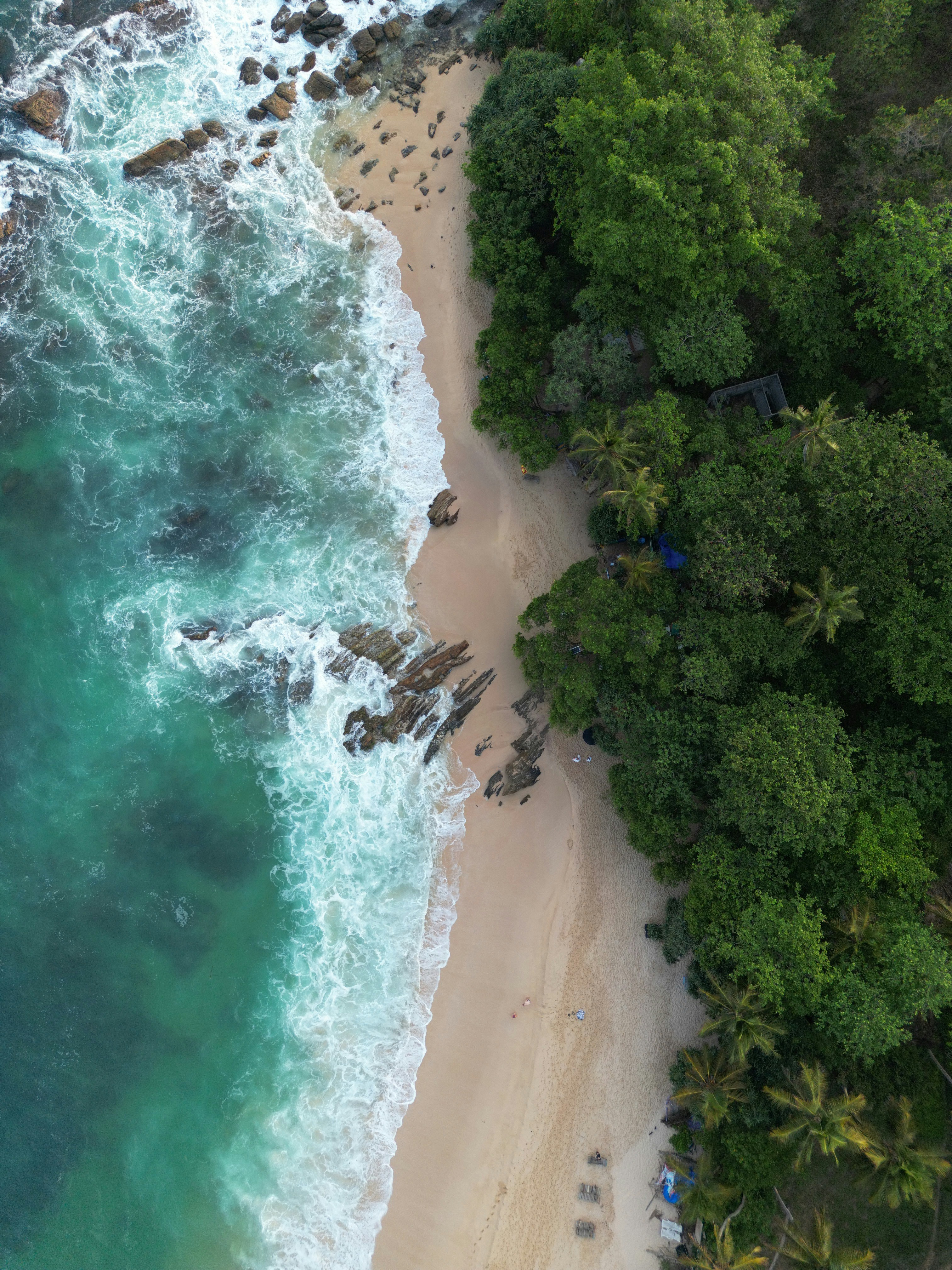
A long, lonely stretch of soft sand backed by dunes and scrub. At one end, a small white temple sits on a rocky headland. The wind is steady; the surf is rough; you can walk for half an hour without seeing another person. Beyond the dunes, the bush stretches inland into Yala’s outer wilderness.
The Story
Kirinda Beach lies on the southern coast of Sri Lanka, about 12 kilometres east of Tissamaharama and immediately west of the main Yala National Park entrance. The beach is genuinely undeveloped — a stretch of about 5 kilometres of sand backed by low dunes and dry scrub forest, with no resort cluster, no string of beach restaurants, and only a small fishing community along the headland.
The headland at Kirinda is crowned by a small white temple — Kirinda Vihara — built around a much older shrine that local tradition associates with Queen Vihara Maha Devi, a 2nd-century BCE Sri Lankan princess. The legend has it that she was set adrift on a small boat from northern Sri Lanka as a religious sacrifice during a great flood, and washed ashore here. She later married King Kavantissa and became the mother of King Dutugemunu, the unifier of ancient Sri Lanka. The temple, while modest in scale, carries a long thread of devotion.
The 2004 tsunami devastated Kirinda. The wave struck this stretch with particular force — the small fishing village immediately east of the temple was almost entirely destroyed, with significant loss of life. The community has rebuilt, slowly and partially; you’ll see the new structures alongside the older patterns of life. The beach itself is unchanged: long, wide, and largely empty.
The swimming at Kirinda is unsafe. The Indian Ocean here has a strong rip current and a steep beach gradient; several drownings have occurred. Walk the wet zone, paddle at the very edge, sit on the sand — but do not swim. The image in our caption a long bay before the park gate — empty sand, low dunes — captures the wild character of the place.
What You'll Experience
Visit at dawn, before a Yala safari, or in the late afternoon for sunset. Both work. The drive from Tissamaharama is about 20 minutes; your safari driver will often include a Kirinda stop on the way to or from the park.
Park near the small temple complex. The temple itself is reached by a stone stair up the headland — about 50 steps, easy. Leave shoes at the gate. The shrine is small, with a Buddha figure in the inner sanctum and a few smaller painted side-rooms. The local devotional traditions overlap with the Vihara Maha Devi legend; you’ll see small offerings — flowers, oil lamps — left by pilgrims. The image in our caption a small temple sits on the headland lands here.
Walk the beach below. The sand is soft and pale. Walk east along the wet zone for as long as you have time. Within ten minutes, you’ll be out of sight of any structure. The dunes rise on your left; the open sea stretches to your right. Sea turtles nest on this stretch from October to April; you may find tracks in the sand at first light. Do not handle eggs or hatchlings if you encounter them; the beach is part of an informal community conservation effort.
Sit for a while on the sand. The contrast between the wildness of the beach and the scale of the wilderness behind it — Yala’s buffer forest stretches inland for kilometres — gives Kirinda a particular quality you don’t find at the more developed south-coast beaches. Walk back to the car. By the time you reach Tissamaharama for breakfast, the safari jeep will be ready for the morning drive.
Practical Details
- Location: About 12 km east of Tissamaharama, immediately west of Yala National Park, Southern Province
- Getting There: A 20-minute drive from any Tissamaharama hotel. Easy combination with a Yala safari pickup.
- Best Time to Visit: November to April. Dawn or late afternoon for the best light. Avoid the lunchtime heat.
- Entry: Free for the beach. Temple visits welcome a small donation.
- What to Bring: Modest clothing for the temple, sturdy sandals, water, hat, sunscreen, light layer for the breeze. No swimwear (the beach is not swimmable).
Pair It With
- Yala National Park — A 15-minute drive east — combine a Kirinda dawn with a Yala morning safari.
- Tissamaharama Lake — A 20-minute drive west — combine for a full pre-safari morning.
- Mulkirigala Rock Temple — On the road back to the south coast — a different cave temple to round out a southern itinerary.
Why It Belongs on Your Sri Lanka Journey
Kirinda is the wild edge of the south coast, a contrast to the more sociable beaches of Mirissa and Tangalle. We slot it in as a half-hour stop on the morning of a Yala safari, paired with the temple visit and the long beach walk. For Belgian and Dutch travellers used to the careful management of European coastal nature reserves, the unpoliced, unmonitored quality of Kirinda lands as something genuinely different — a small reminder that the southern Indian Ocean still has stretches of coast where the rules are written by tide and wind rather than by signage.
Plan your visit to Kirinda Beach with DBRO
We design slow, considered Sri Lanka itineraries from our base on the island, with a particular ear for travellers from the Netherlands and Belgium. If Kirinda Beach is on your shortlist, we’ll fit it into a route that lets it breathe.
Useful next reads:

