
You step out of the shade of the trees and there it is — a brick mountain the colour of old terracotta, the air around it humming with cicadas. Pilgrims in white drift past in slow, unhurried lines. Something in your shoulders drops a notch.
The Story
Built in the third century after a doctrinal schism within the Anuradhapura sangha, Jethawanaramaya was raised by King Mahasena to anchor a new monastic order. When it was completed it stood somewhere around 122 metres tall — for a moment it was the third-tallest structure on earth, surpassed only by two of the Egyptian pyramids. Time, weather and a thousand years of neglect rounded its summit, but its bulk remained. The bricks alone, locals will tell you, would build a wall from London to Edinburgh, and they don’t seem to be exaggerating much.
A small relic of the Buddha is said to rest somewhere in the dome — by tradition, a piece of the sash worn at his death. Whether or not you carry that belief, the scale of the monument is a kind of devotion in itself. Each brick was hand-pressed and stacked by labourers whose names history has not preserved. They built, in effect, a hill.
Restoration began under the Cultural Triangle programme in the 1980s and continues quietly today. Walk the perimeter slowly and you’ll see the patchwork — older bricks worn round at the edges, newer ones still sharp. The site sits within Anuradhapura’s sacred city, a UNESCO World Heritage Site, alongside Ruwanwelisaya, Sri Maha Bodhi and the ancient palace ruins. To Sri Lankan Buddhists this is not a museum but a living place of worship; you will see flowers, oil lamps and the soft chant of devotees moving from stupa to stupa in pradakshina, the clockwise circumambulation of the sacred.
What You'll Experience
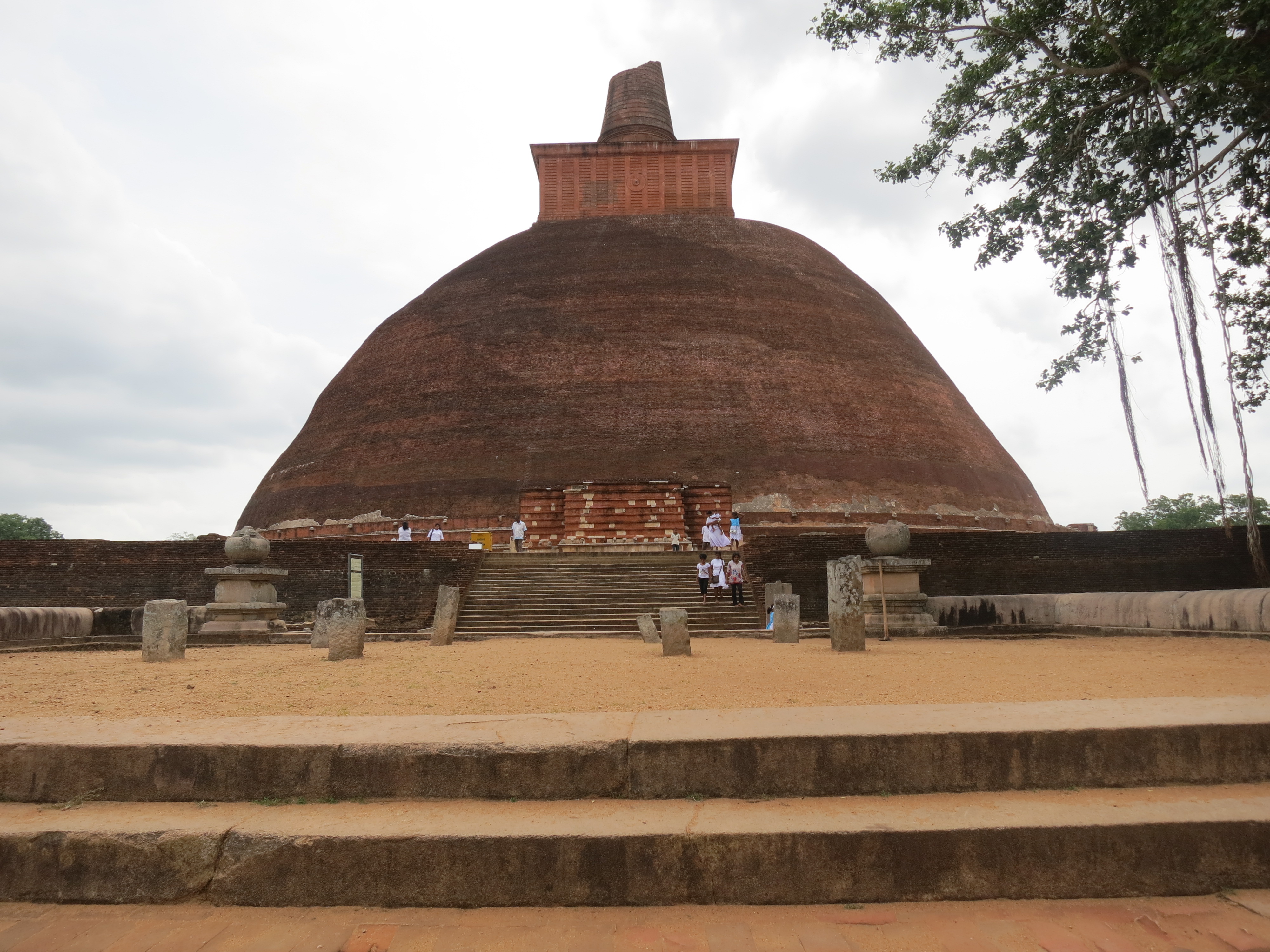
Arrive early — by half past seven the sun is already telling you what kind of day it’ll be. You leave shoes and hat at the entrance (bare feet on warm stone is part of the deal here) and walk barefoot onto the polished platform. The dome rises in front of you the way a rain cloud rises: too big to take in all at once.
Walk clockwise. There is no rush. You’ll pass small shrine rooms in each cardinal direction, each with a Buddha statue set behind a plain railing. White-clad pilgrims press lotus flowers and frangipani into the offering plates; the smell is honeyed and slightly green. Children sit in the shade with grandparents, watching everything.
Look up close at the brick. There are pockets where weather has eaten patterns into the surface like old cloth, and you can pick out the join lines of medieval repairs. A stone Buddha smiles from a niche, eroded almost smooth. Cicadas saw away in the trees beyond the wall. From the platform’s northern edge, the white dome of nearby Ruwanwelisaya floats above the canopy — your next walk, if you have the legs.
Practical Details
- Location: Anuradhapura sacred city, North Central Province
- Getting There: About 4 hours by car from Colombo, 3 hours from Sigiriya. Inside the sacred city the stupas are spread over several kilometres — bicycles or a tuk-tuk are useful.
- Best Time to Visit: Dry season May to September. Visit at sunrise or in the last hour before dusk to avoid the midday heat.
- Entry: A combined Sacred City ticket (around USD 25 for foreign visitors at time of writing — verify current rates) covers Jethawanaramaya, Ruwanwelisaya and Sri Maha Bodhi.
- What to Bring: Modest clothing covering shoulders and knees, a sarong for extra cover if needed, water, a hat for between sites, and socks if hot stone underfoot is a concern.
Pair It With
- Ruwanwelisaya — The white-domed Great Stupa, ten minutes by tuk-tuk and the visual counterpoint to Jethawanaramaya’s raw brick.
- Sri Maha Bodhi — The sacred Bodhi tree, said to be the oldest documented tree in the world.
- Mihintale — A short drive away, the mountain-top temple where Buddhism first took root in Sri Lanka.
Why It Belongs on Your Sri Lanka Journey
Jethawanaramaya is one of those places that doesn’t announce itself. It just keeps standing there, century after century, while the trees around it come and go. For travellers from Amsterdam, Brussels or anywhere else in Europe used to cathedral-cool stone, the heat and the bare-feet ritual will feel new — and probably more grounded than they expect. Build it into a slow Cultural Triangle loop with Sigiriya and Polonnaruwa rather than a single rushed day, and the place gets a chance to do its quiet work.
Plan your visit to Jethawanaramaya with DBRO
We design slow, considered Sri Lanka itineraries from our base on the island, with a particular ear for travellers from the Netherlands and Belgium. If Jethawanaramaya is on your shortlist, we’ll fit it into a route that lets it breathe.
Useful next reads:

