
A short, steep climb through a wooded hillside, and suddenly the trees open. A white stupa sits on a flat headland of grass and stone, and beyond it the entire arc of Unawatuna Bay falls away to the horizon, with Galle Fort’s lighthouse just visible on the far side.
The Story
The Japanese Peace Pagoda on Rumassala Hill is one of about 80 such pagodas built around the world by the Nipponzan-Myōhōji order — a small Japanese Buddhist movement founded in 1917 by Nichidatsu Fujii, dedicated to world peace through the building of stupas. The first peace pagoda was raised in Hiroshima in 1954, in direct response to the atomic bombing; the rest, including this one, are gestures of solidarity and a long, quiet protest against war.
The Galle pagoda was completed in 2005 and consecrated by Japanese and Sri Lankan monks. It sits on Rumassala Hill — a hill that, according to the Ramayana, is itself a fragment of the Himalayas, dropped here by the monkey-god Hanuman as he carried medicinal herbs to heal the wounded warrior Lakshmana. The local name for the hill, Buona Vista, dates from the Portuguese era. Like much of the south coast, the pagoda survived the 2004 tsunami because of its elevation, and the small monastic community on the hill became one of the early refuges for survivors.
The pagoda is genuinely small — about 15 metres tall — but its setting is what makes it. The hill drops away in every direction: to the west, Galle Fort and its lighthouse; to the south, the Indian Ocean and the curve of Unawatuna Bay; to the north, the working harbour and the lowlands beyond. On a clear day you can see the bend of the south coast for forty kilometres in either direction.
What You'll Experience
Take a tuk-tuk from Unawatuna or Galle Fort to the trailhead at the base of the hill. The path up is short — about 15 minutes — but steep, with rough stone steps in places. A small Buddhist monastery sits just below the summit, and you’ll usually pass a few monks in saffron going up or down.
At the top, the pagoda stands on a paved platform of pale stone. You walk clockwise around it, as you would around any stupa. There are four small Buddha figures set into the cardinal directions of the dome, each in a different mudra — earth-touching, meditation, teaching, fearlessness. The wind off the ocean is steady; the air smells of incense and warm grass.
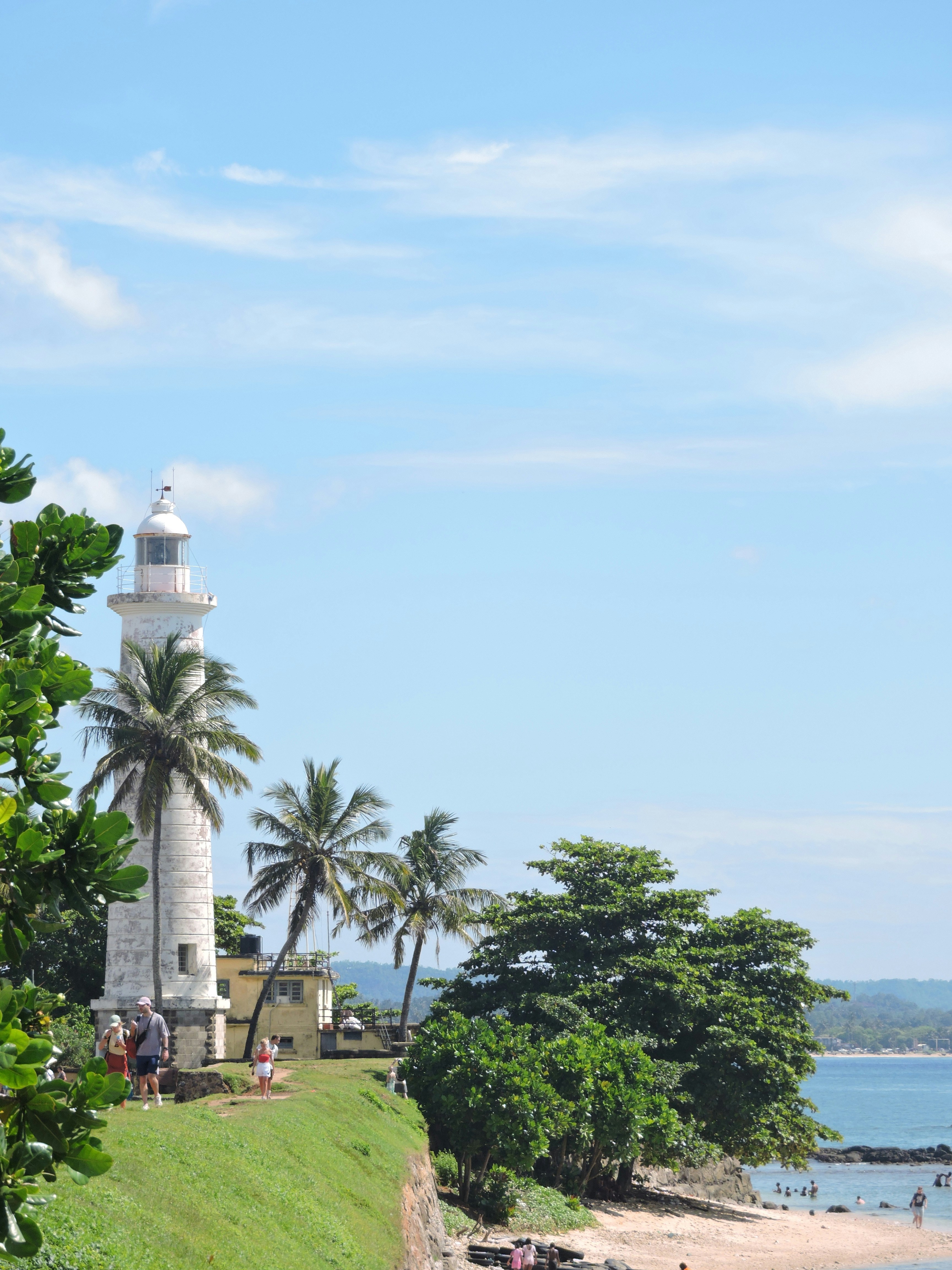
Move to the western edge of the platform. The view back toward Galle Fort is, on a clear afternoon, breathtaking — the white lighthouse, the brown of the ramparts, the green of the cricket green, the deep blue of the bay. To the south, Unawatuna Beach curves away below you in a perfect crescent, and you can see surfers as small dots on the water. Spend half an hour. You are unlikely to share the platform with more than a few other travellers and a couple of local monks. By the time you leave the light has gone soft, and you’ll know exactly where to go for dinner — the bay below.
Practical Details
- Location: Rumassala Hill, between Galle and Unawatuna, Southern Province
- Getting There: About 10 minutes by tuk-tuk from Galle Fort or Unawatuna. The trail to the pagoda is signposted from the road.
- Best Time to Visit: Late afternoon for sunset, year-round. Avoid heavy rain — the path is slippery.
- Entry: Free. A small donation to the monks is welcome but not expected.
- What to Bring: Sturdy shoes, water, modest clothing for the temple platform, a hat for the open hilltop, and a light layer for the windier evening.
Pair It With
- Unawatuna Beach — The bay below — combine the pagoda with a swim and dinner on the sand.
- Galle Fort — 10 minutes by tuk-tuk; pair with a morning fort walk and an afternoon hilltop visit.
- Galle Lighthouse — The lighthouse seen from the pagoda is one of the south coast’s great views.
Why It Belongs on Your Sri Lanka Journey
The Japanese Peace Pagoda is the small, quiet alternative to Galle Fort’s tourist crowds — a 15-minute climb, a panoramic view, and a working temple where two languages of Buddhism (Sri Lankan Theravada and Japanese Nichiren) meet on the same hilltop. Build it into a south-coast itinerary as a late-afternoon stop, somewhere between a Galle Fort breakfast and an Unawatuna sunset dinner.
Plan your visit to Japanese Peace Pagoda with DBRO
We design slow, considered Sri Lanka itineraries from our base on the island, with a particular ear for travellers from the Netherlands and Belgium. If Japanese Peace Pagoda is on your shortlist, we’ll fit it into a route that lets it breathe.
Useful next reads:

