
Walk through the main gate and the city changes. The traffic falls away. Coral-stone walls rise on both sides, bougainvillea spills over a balcony, and somewhere up ahead a cricket match is starting on the green. The Indian Ocean glints between two old houses. You’ve stepped out of one century and into another, and you’re already glad you booked two nights instead of one.
The Story
Galle Fort is the most complete fortified colonial-era town in South Asia. The Portuguese built the first wooden fortifications here in 1588 to protect their harbour and trading interests. The Dutch took the port in 1640 and rebuilt the fort in stone — coral, granite and limestone — in the form you see today: a 90-acre walled town with bastions named for the cardinal directions, a working harbour, churches, warehouses, government buildings, and the gridded street pattern that gives the fort its quiet, walkable atmosphere.
The British arrived in 1796 and largely left the fort as they found it, adding a lighthouse, a couple of churches, and a clock tower. Through three colonial periods and into independent Sri Lanka, the fort kept its character — a small island of European-style streets surrounded by the busier, more typically Sri Lankan town of Galle outside the walls. UNESCO inscribed the fort as a World Heritage Site in 1988.
Today the fort has roughly 400 buildings inside its walls, of which the great majority are colonial-era. About half are now boutique guesthouses, restaurants, jewellery shops and galleries, and the other half are still Sri Lankan family homes. You’ll see laundry on lines a few doors down from a Michelin-style tasting menu. Children play cricket against the walls of the old Dutch warehouse. A muezzin calls from the small mosque inside the fort. It’s an extraordinary, working, ordinary place.
What You'll Experience
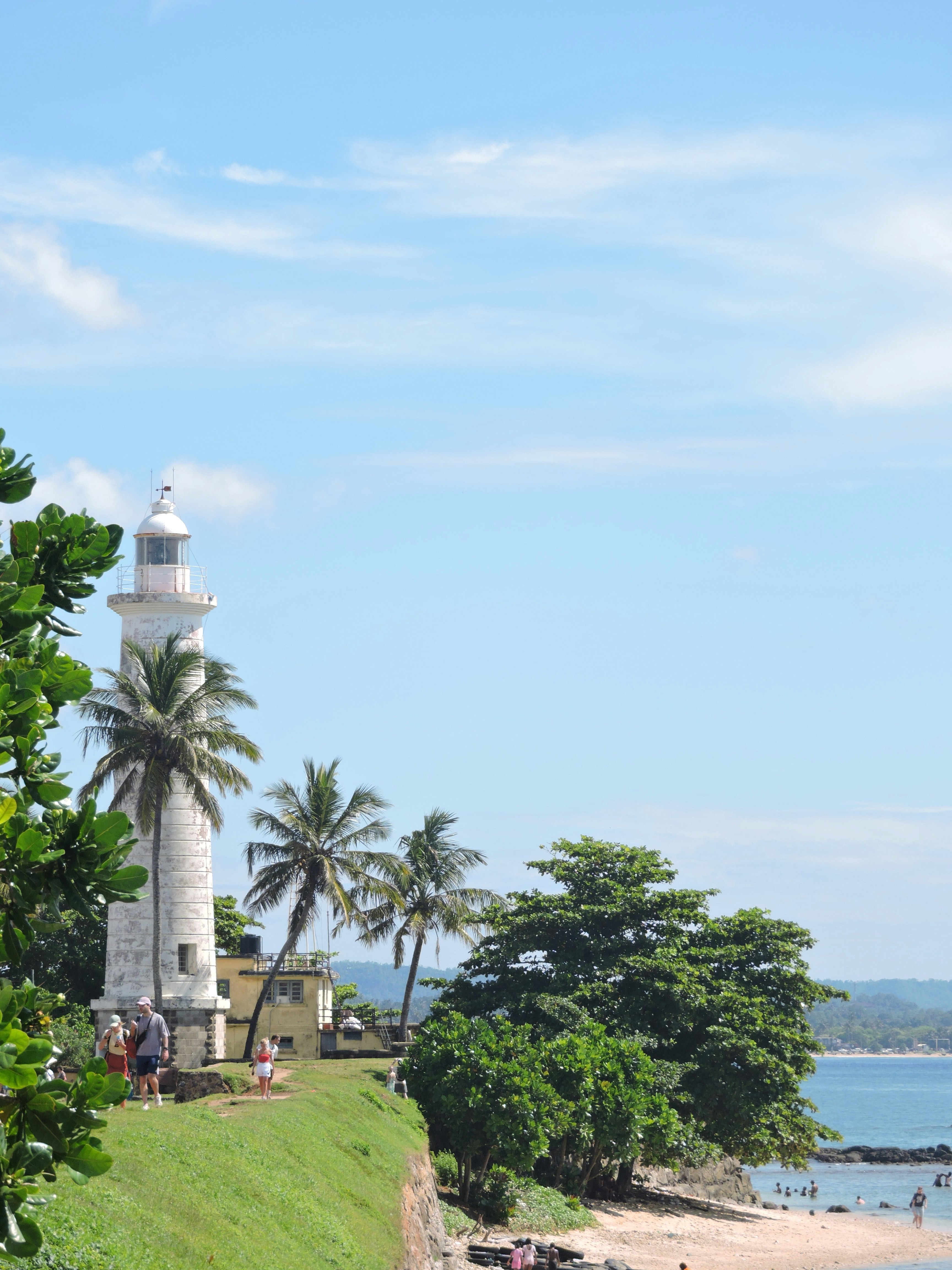
Spend at least one full day walking the walls. Start at the New Gate, climb the rampart, and follow it clockwise. From up here you see the entire fort laid out in tile and palm — the lighthouse, the cricket green, the spire of the Dutch Reformed Church, and beyond the wall the long curve of Galle Bay. The wall itself is wide enough to walk two-abreast, and you’ll share it with joggers, lovers, courting couples, and small boys flying kites.
Drop down for breakfast at one of the boutique cafes around Pedlar Street. Walk Church Street and Leyn Baan Street — the most photogenic in the fort — at the start or end of day, when the light is on the lime-washed walls. Visit the National Maritime Museum (small, free, and surprisingly good) and the Dutch Reformed Church (1755) with its 17th-century tombstones laid into the floor.
In the late afternoon, the fort wakes up. The cricket match draws to a close. Tuk-tuks idle outside the boutique hotels. Locals walk the ramparts in white. You climb to the lighthouse end of the wall — half the town is up there with you — and watch the sun drop into the Indian Ocean. The wind is steady and warm. Behind you, Galle Fort lights up in lanterns and shop signs. You go down for dinner; you go to bed late; you wake the next morning and start again.
Practical Details
- Location: Galle, Southern Province — about 120 km south of Colombo
- Getting There: About 1.5 hours by car from Colombo on the Southern Expressway. The coastal train from Colombo is slower (about 2.5 hours) but very scenic.
- Best Time to Visit: November to April (south-west dry season). May to October brings monsoon weather, though Galle still has many sunny days.
- Entry: Free to walk in. Most museums charge a small fee.
- What to Bring: Light, breathable clothing, a hat, sunscreen, a swimsuit (you’ll likely visit nearby beaches), and comfortable shoes for the cobbled lanes.
Pair It With
- Unawatuna Beach — A 10-minute tuk-tuk from the fort — afternoons of swimming and a long beach dinner.
- Galle Lighthouse — On the southern bastion of the fort itself — a 5-minute walk from anywhere inside the walls.
- Japanese Peace Pagoda — A short drive away, with sweeping views over Unawatuna Bay.
Why It Belongs on Your Sri Lanka Journey
Galle Fort is the rare colonial-era town that has been allowed to keep being a town. It’s walkable, lived-in, photogenic without being a stage set, and its food and design scenes give the south coast a depth that pure beach destinations don’t. Build it into a Sri Lanka loop with two nights minimum. For Dutch travellers in particular, the streetscape — Leyn Baan, Pedlar Street, the Dutch Reformed Church — feels both familiar and re-imagined under a south-Asian sun.
Plan your visit to Galle Fort with DBRO
We design slow, considered Sri Lanka itineraries from our base on the island, with a particular ear for travellers from the Netherlands and Belgium. If Galle Fort is on your shortlist, we’ll fit it into a route that lets it breathe.
Useful next reads:

