
You climb a long stair of warm stone past a giant gold Buddha set into the rock face below. At the top, you cross a flagstone terrace and step into a cave whose ceiling is painted from end to end with Buddhas, lotus medallions, and the thousand small figures of the Mahayana cosmos. The smell is sandalwood and old plaster.
The Story
The Dambulla Royal Cave Temple — locally Rangiri Dambulla Viharaya, the Golden Rock Temple — is the largest and best-preserved cave temple complex in Sri Lanka. Five rock-cut caves on the southern face of a granite outcrop hold over 150 Buddha statues, three statues of Sri Lankan kings, and roughly 2,100 square metres of painted ceiling and wall surfaces. The earliest caves date to the 1st century BCE, when the dispossessed king Valagamba sheltered here for fourteen years during a south Indian invasion of Anuradhapura. After regaining his throne, he commissioned the first temple inside the caves in gratitude. Successive kings — particularly Nissanka Malla in the 12th century and the Kandyan kings of the 17th and 18th centuries — added the murals and statues we see today.
The complex is a UNESCO World Heritage Site, inscribed in 1991. The five main caves vary in size, layout, and painting style: the first cave (the Cave of the Divine King) holds a 14-metre reclining Buddha carved from the living rock; the second (the Cave of the Great Kings) is the largest and most impressive, with a painted ceiling that has become the iconic image of Dambulla; the smaller caves contain individual Buddha statues, royal portraits, and dense narrative murals retelling the life of the Buddha.
At the foot of the rock, separate from the historic caves, stands a 30-metre golden Buddha statue completed in 2000. It is, generally, not loved by art historians or by long-term Buddhist devotees — it is recent, oversized, and stylistically very different from the caves above. But it is hard to miss, and it provides the orientation point for visitors arriving from the road below. The image of the giant gilded Buddha at the foot of the cave in our caption refers to this 2000-era statue; the painted ceilings and the painted ceilings of Dambulla in the photo refer to the historic caves above.
What You'll Experience
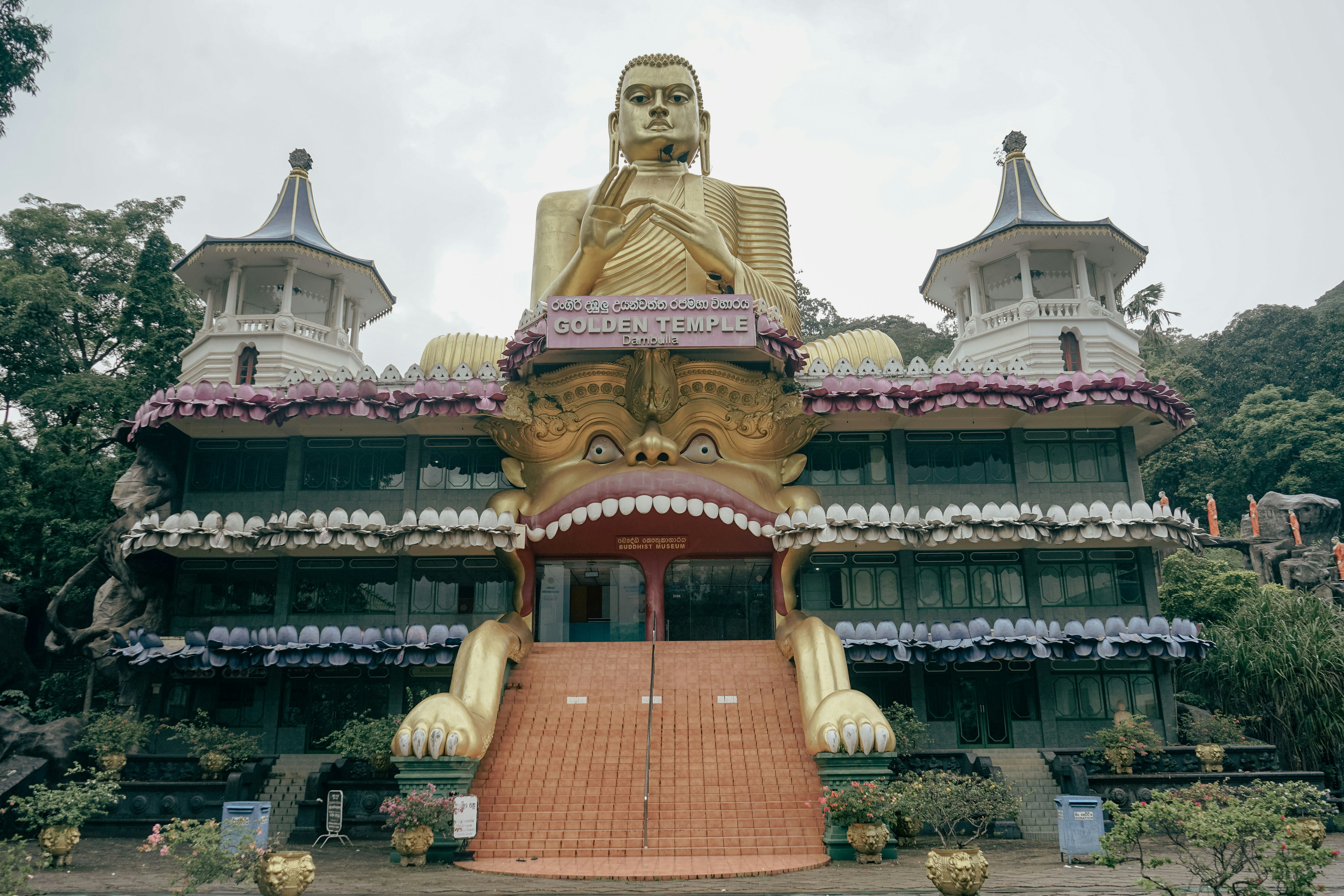
Arrive in the morning before the heat builds — most travellers come at 9am or so, and the queue stays manageable. From the road, you’ll see the giant gold Buddha first; the path to the historic caves climbs up a stone stair past a small museum and through a frangipani-shaded courtyard. Allow about 15 minutes to climb up, and a similar time down.
At the top, leave shoes at the entrance. The flagstones are warm; bring socks if you’re sensitive. The five caves open off a single long terrace. Walk into the first cave — the Cave of the Divine King — and let your eyes adjust. The reclining Buddha runs almost the full length of the cave, his right hand under his head, his face calm. The painting on the rock above him still carries pigment from the Kandyan period.
Move into the second cave. This is the iconic one. The ceiling is solid painting from edge to edge — Buddhas seated, standing, teaching, in repeating geometric arrangements that make the rock surface itself feel like a vast manuscript. There’s no flash photography, but the ambient light is enough; spend time here. The image in our caption the painted ceilings of Dambulla lands in this cave. Sri Lankan pilgrims sit on the floor in white clothing; monks in saffron occasionally pass through in silence. The cave smells faintly of sandalwood and incense smoke.
The remaining three caves are smaller and more intimate, with individual Buddha statues, donor portraits of the kings who funded the works, and a sequence of murals telling the story of how Buddhism came to the island. Don’t rush. Walk back out into the courtyard, take a long drink of water, and walk down the stair past the giant gold Buddha to your driver.
Practical Details
- Location: Dambulla, Central Province — about 19 km south-west of Sigiriya
- Getting There: About 25 minutes by car from Sigiriya, 4 hours from Colombo via the new expressway. Parking at the foot of the rock.
- Best Time to Visit: Year-round; mornings (around 9am) are quietest. Avoid the midday heat. The complex is open year-round.
- Entry: Around USD 10–12 for foreign visitors (verify current rates). Cameras allowed but no flash inside the caves.
- What to Bring: Modest clothing covering shoulders and knees, a sarong as backup, socks for hot stone, water, hat, sunscreen, comfortable shoes for the climb.
Pair It With
- Sigiriya Rock Fortress — Pair Dambulla with a Sigiriya climb the same morning, or split across two days.
- Pidurangala Rock — The lower-effort climb opposite Sigiriya — pair the cave temple with a Pidurangala sunrise.
- Minneriya National Park — A late-afternoon safari for the Gathering of elephants — combine with a morning at Dambulla.
Why It Belongs on Your Sri Lanka Journey
Dambulla is the quiet, layered counterpart to the showier Sigiriya climb. The painted ceilings reward a slow visit; the carved Buddhas reward another. We typically build the cave temple into a Cultural Triangle stay of three nights minimum, with Sigiriya at sunrise, Dambulla in the morning, an afternoon nap, and Minneriya for the evening safari. For travellers from Amsterdam used to the chronological depth of medieval Europe, the simple presence of 2,000-year-old painted rock is the kind of moment that recalibrates the trip.
Plan your visit to Dambulla Cave Temple with DBRO
We design slow, considered Sri Lanka itineraries from our base on the island, with a particular ear for travellers from the Netherlands and Belgium. If Dambulla Cave Temple is on your shortlist, we’ll fit it into a route that lets it breathe.
Useful next reads:

